
If you are serious about building a long-term career in the UK, the first question you need to answer is simple. Do you have the qualifications that employers actually require?
In 2026, the answer to that question matters more than ever. Construction sites, railway projects, and security operations across the UK are tightening their compliance requirements. Workers without the right certificates are being turned away at the gate. Contractors are facing fines for hiring unqualified staff. And the gap between what a certified worker earns and what an uncertified worker earns keeps growing every year.
The good news is that getting qualified has never been more accessible. Whether you want to work on a construction site, operate heavy plant machinery, protect people as a security professional, or keep UK railways running safely, there is a clear training pathway available right now.
At JFK Tech Training, we deliver accredited courses across construction, railway, security, CPCS plant operations, and NVQ professional qualifications. This guide covers every course we offer, explains exactly who needs each one, and tells you what to expect when you enroll. By the end of this article, you’ll know which course is right for you and how to start.
Why This Matters in 2026
The UK construction industry alone employs over 2.2 million workers. The security sector employs more than 350,000 licensed professionals. The rail industry supports over 700,000 jobs. Every single one of those roles requires verified, accredited qualifications. Without them, you cannot work.
Construction Training Courses
Construction is one of the most qualification-driven industries in the UK. It is not enough to turn up to a site and say you know what you are doing. Employers and principal contractors need to see your certificates before you set foot inside the hoard. The Construction Skills Certification Scheme (CSCS) card system underpins most of these requirements, and your CSCS card category depends directly on the qualifications you hold.
JFK Tech Training offers the two most important management-level construction qualifications available in the UK today. Both are delivered flexibly so you can train without sacrificing weeks of work.
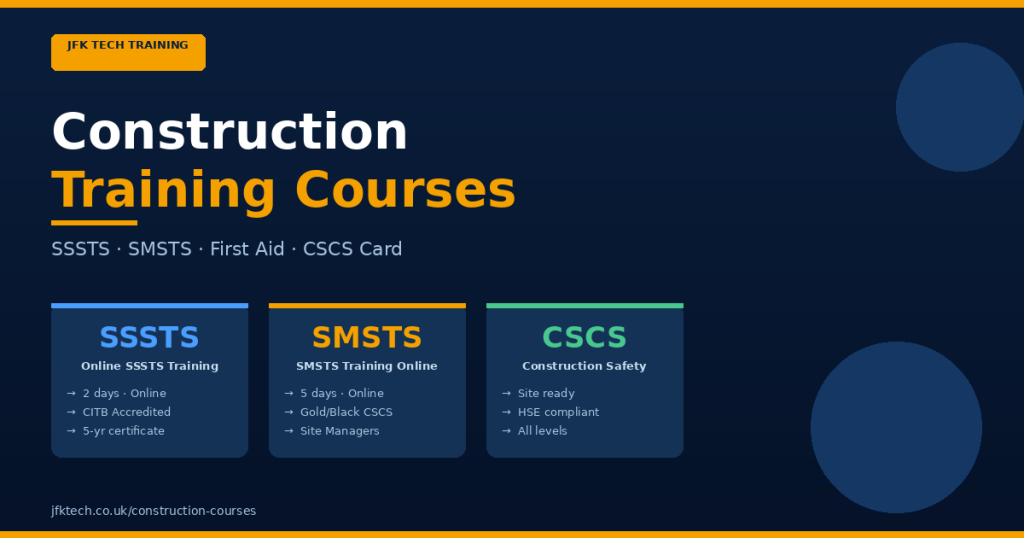
Online SSSTS Training
The Site Supervisor Safety Training Scheme, known as SSSTS, is the recognized standard qualification for anyone supervising workers on a UK construction site. If you are a gang leader, a working foreman, or anyone responsible for managing people on site, this is the course you need.
Our online SSSTS training is delivered over two days and covers everything a site supervisor needs to understand about health and safety law, risk assessments, toolbox talks, and accident reporting. The course is assessed through a written test, and you receive a CITB SSSTS certificate if you pass. That certificate is valid for five years and is required to apply for the Blue or Gold CSCS card.
The online format means you can complete the course from home or from site accommodation without taking extended time away from work. Supervisors who hold an SSSTS certificate are taken more seriously on site. Main contractors expect it. If you want to move from operative to supervisory, your certificate is the qualification that opens that door.
Who needs SSSTS?
| Who needs SSSTS? Anyone supervising workers on a UK construction site. Required for Blue and Gold CSCS card applications at the supervisor level. | How long does it take? Two days. Delivered online with live trainer sessions. Certificate valid for five years with a refresher renewal option. |
SMSTS Training Online
The Site Management Safety Training Scheme, known as SMSTS, is the gold standard qualification for site managers, project managers, and anyone acting as the principal contractor on a UK construction project. It is not optional for these roles. Major contractors including Balfour Beatty, Kier, Laing O’Rourke, and Morgan Sindall all make SMSTS a mandatory requirement before offering management contracts.
Our SMSTS training online runs over five days and covers health and safety legislation, CDM Regulations, risk management, environmental responsibilities, and the legal duties of a site manager. You receive a CITB SMSTS certificate on successful completion, valid for five years.
The SMSTS qualification is directly linked to salary. Site managers with an SMSTS certificate consistently earn significantly more than those without it. The certificate also supports your application for the Gold and Black CSCS card categories, which are required for senior site management roles.
Did You Know?
SMSTS is one of the highest return on investment qualifications in UK construction. The certificate pays for itself many times over through higher day rates, better contract opportunities, and access to senior management roles that are otherwise closed to uncertified workers.
Read more: SSSTS vs SMSTS: Which Training Course Do You Need?
IOSH Health and Safety Courses
Health and safety is not just a construction topic. Every employer in the UK has a legal duty of care to protect their workers. The Health and Safety at Work Act 1974 applies to offices, warehouses, factories, transport operations, and every other working environment in the country. IOSH training gives workers and managers the tools to meet that duty.
IOSH stands for the Institution of Occupational Safety and Health. It is the world’s largest health and safety professional membership body, and its training programs are recognized by employers across every sector in the UK and internationally.
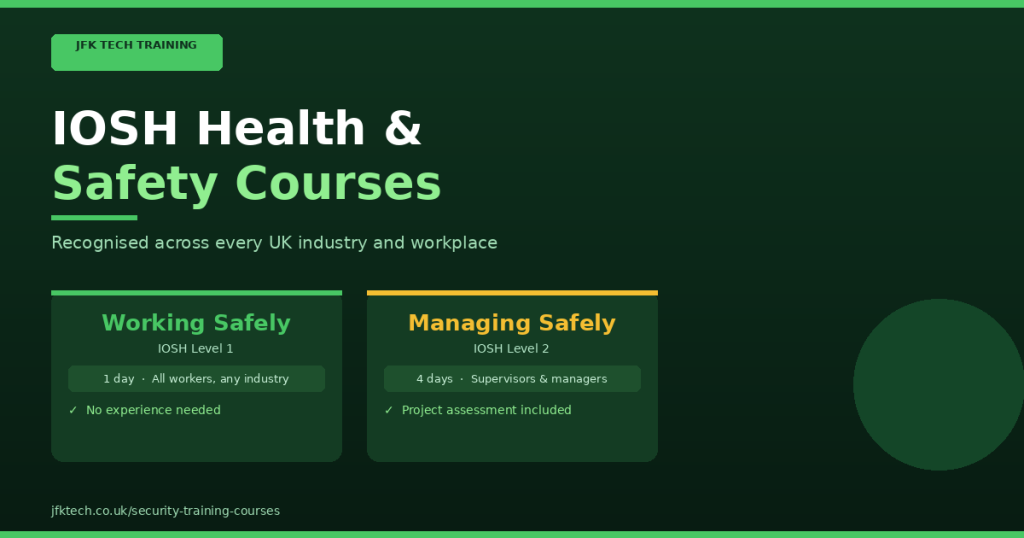
Our IOSH health and safety courses are available at two key levels. IOSH Working Safely is designed for anyone in any job role who needs a basic understanding of health and safety in the workplace. It covers hazard identification, accident reporting, and personal responsibilities. It takes one day to complete and requires no prior knowledge or experience.
IOSH Managing Safely is the step up for team leaders, supervisors, and managers. It covers risk assessment, legal responsibilities, incident investigation, and how to implement a health and safety management system in a practical, non-technical way. It runs over four days and includes a project assessment.
What makes IOSH different from sector-specific qualifications is its universality. If you hold an IOSH certificate, you can use it as evidence of health and safety competence in construction, security, transport, retail, hospitality, or any other workplace.
| IOSH Working Safely One-day course for all workers. Covers personal safety responsibilities, hazard awareness, and basic workplace health and safety law. | IOSH Managing Safely A four-day course for supervisors and managers. Covers risk assessment, legal duties, and incident investigation with a project assessment. |
NVQ Courses
National Vocational Qualifications, known as NVQs, are work-based qualifications that assess your competence through the evidence of your actual job performance rather than through traditional exams. This makes them uniquely valuable for experienced workers who have spent years developing real skills but never had the opportunity to formalize them into a recognized certificate.
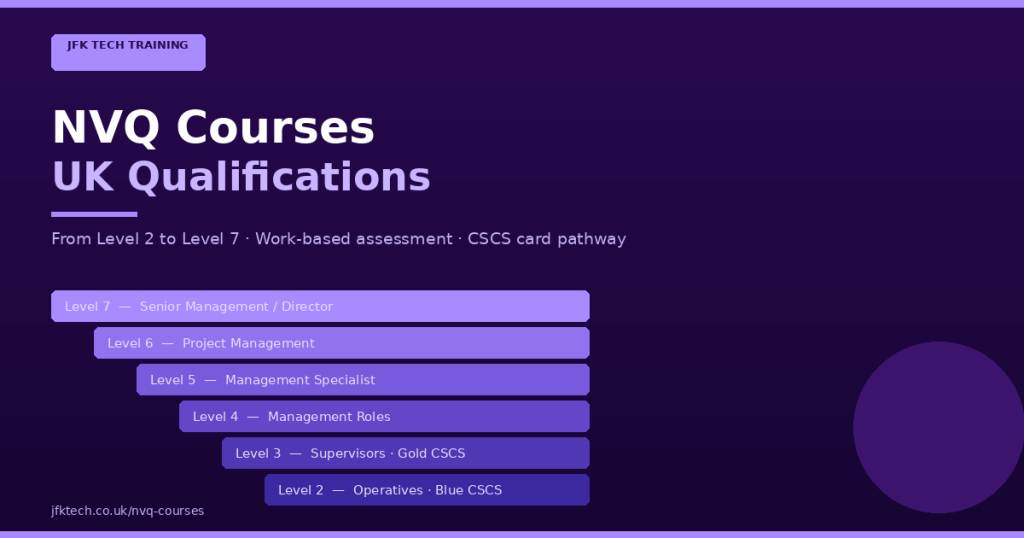
The NVQ framework runs from Level 2 through to Level 7. Each level corresponds to a different stage of a professional career, from skilled operative through senior management and director level. In construction specifically, your NVQ level determines which CSCS card color you are eligible to apply for.
What Each NVQ Level Means
NVQ Level 2 is for skilled operatives and trades workers. It covers the core technical skills of your occupation and supports your application for the Blue CSCS card.
NVQ Level 3 is for advanced operatives and supervisors. A Level 3 NVQ supports your application for the Gold CSCS card.
NVQ Levels 4 and 5 are for management and specialist contractor roles, and they support the Gold and Platinum CSCS card applications.
NVQ levels 6 and 7 are for senior management and director-level roles. These are the highest NVQ qualifications available and are aligned with the Black CSCS manager card requirements.
Important Note on NVQs and CSCS Cards
At JFK Tech Training, we align every NVQ pathway to a specific CSCS card category. When you enroll, we advise you exactly which NVQ level you need for your target CSCS card and which occupation stream is most appropriate for your job role.
NVQs take anywhere from three months to eighteen months to complete depending on the level. They can be completed while you continue working full time because the assessment is based on your actual job rather than requiring you to attend a training center.
Further reading: NVQ Construction Courses Explained: Levels 2 to 7 and Which One You Actually Need
Railway Training Courses

The UK rail industry is one of the most tightly regulated working environments in the country. Network Rail and the Office of Rail and Road enforce a strict safety framework that applies to every single person working on or near the line, without exception.
If you want to work in the rail industry, whether in maintenance, civil engineering, signaling, telecoms, or any other trackside discipline, you must hold the appropriate certifications before you set foot on site.
PTS Training Course London
Personal Track Safety certification, known as PTS, is the foundational safety qualification for UK rail workers. It is a legal requirement under the Health and Safety at Work Act 1974 and Network Rail safety standards. Every person who works on or near a live railway line must hold a valid PTS certificate. This includes contractors, subcontractors, self-employed workers, and direct employees.
Our PTS training course in London is delivered at our CEME Innovation Center in Rainham and covers all mandatory PTS elements, including track awareness, safe systems of work, lookout and warning systems, and emergency procedures. On completion you are registered on the Sentinel: You will be issued a Sentinel card that proves your PTS status to Network Rail and principal contractors.
The PTS certificate is the gateway qualification for rail work. Without it, you cannot access any network rail-managed site. With it, you unlock a sector that offers stable employment, excellent rates of pay, and a clearly defined career ladder from operative to engineering supervisor and beyond.
Track Induction Course London
A track induction is a site-specific safety briefing that every worker must complete before starting work on any Network Rail-managed project. It is separate from your PTS certificate and is required even if you already hold full PTS certification.
Our track induction course in London covers all the Network Rail requirements for site-specific induction. It ensures that every worker on your project understands the local rules before they start, which is both a legal requirement and a fundamental piece of effective site management.
| PTS Training London Mandatory for all UK rail workers. Covers tracking safety laws, protection systems, and sentinel registration. Delivered at CEME, Rainham. | Track Induction London A site-specific briefing is required before starting any rail project. Mandatory regardless of existing PTS certification. |
Legal Requirement
Working on or near UK railway lines without a valid PTS certificate is a criminal offense under the Health and Safety at Work Act 1974. Network Rail conducts regular spot checks, and workers found without valid certification are removed from the site immediately.
Further reading: What is PTS Training? Everything You Need to Know Before Working on Tracks
Also see: Are Railway Training Courses Mandatory for Working on UK Rail Sites?
CPCS Courses

The Construction Plant Competence Scheme, known as CPCS, is the recognized certification system for plant operators across the UK construction industry. If you want to legally operate any category of construction plant machinery on a commercial site, you need a valid CPCS card.
The CPCS card system works in two stages. First, you earn a red CPCS card by passing the relevant CPCS theory test and a practical assessment for your chosen plant category. During that period, you must complete an NVQ to convert your red card to a blue CPCS card, which is the competent operator card renewed every five years.
Traffic Marshall Course
The traffic marshall course prepares you for the CPCS A73 theory and practical assessments. Traffic marshals are responsible for controlling the movement of vehicles, plants, and pedestrians on and around construction sites. They prevent accidents involving HGVs reversing into workers, dumpers crossing pedestrian routes, and excavators operating too close to site boundaries.
In 2026, the demand for qualified traffic marshalls is exceptionally high. The volume of infrastructure projects running across the UK means that main contractors need trained marshalls on virtually every active site.
Our traffic marshall course covers everything you need to pass the CPCS A73 test including hand signal systems, communication methods, site safety rules, and the practical skills required to direct traffic safely. On passing the A73 test, you receive your red CPCS traffic marshall card and can work on any CPCS scheme site in the UK.
High-Demand Role in 2026
Traffic marshalls are among the most consistently in-demand operatives on UK construction sites. The combination of relatively quick qualification time and strong ongoing demand makes it one of the most practical career starting points in construction.
Further reading: How to Pass Your CPCS Traffic Marshall A73 Test First Time
Security Training Courses
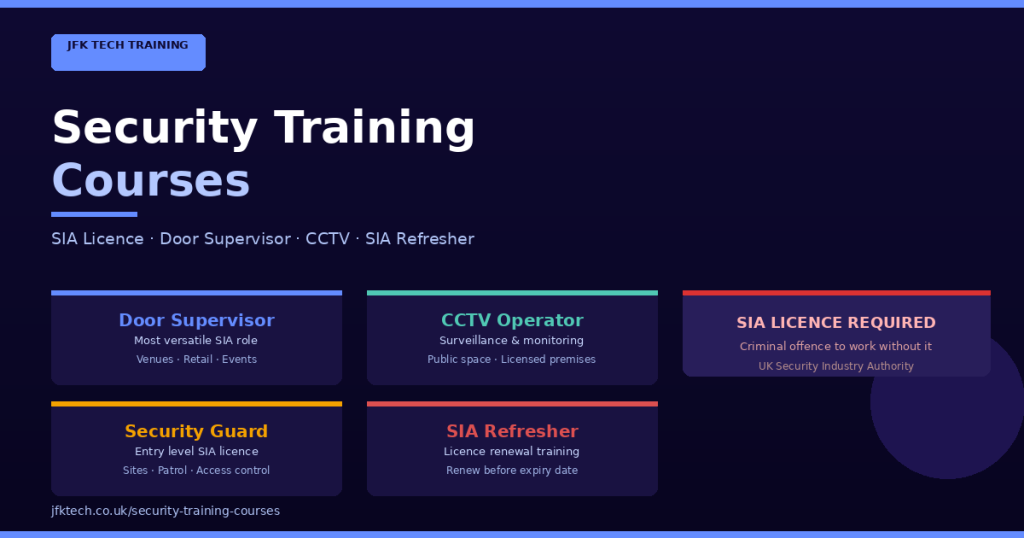
The UK security industry is one of the most regulated employment sectors in the country. Every person working in a licensable security role must hold a valid license issued by the Security Industry Authority, known as the SIA. Working in a licensable role without an SIA license is a criminal offense regardless of whether you are employed directly, working as a subcontractor, or self-employed.
The security industry offers genuine career opportunities. Entry-level door supervisors in London earn competitive hourly rates, and experienced professionals who progress into close protection, security management, or corporate security roles can earn very well.
SIA License Courses
JFK Tech Training delivers SIA license training for door supervisors, CCTV operators, and security guards. Each license has its own training pathway, but all of them include mandatory first aid training as a component. You cannot apply for an SIA license without a valid first aid certificate.
The door supervisor license is the most versatile SIA qualification. It allows you to work on the door at licensed premises, in retail security, at events, and in a range of other security environments. It is also the pathway to more specialized roles, such as close protection.
The CCTV operator license is required for anyone working in a regulated CCTV monitoring role. The training covers camera operation; relevant legislation, including the Data Protection Act and Surveillance Camera Code of Practice; and incident reporting.
SIA Refresher Course
Your SIA license is valid for three years. Before it expires, you must complete a renewal process that includes a refresher training element. Our SIA refresher course covers the updated This includes legislation, revised first aid requirements, and any changes to the SIA license criteria that have come into effect during your current license period.
Many security professionals leave their renewal very late and end up with a gap in their license. A gap means you cannot legally work in a licensable role until the new license is issued. If your license is within six months of its renewal date, book your refresher now.
| New SIA Licence Full training for door supervisors, CCTV operators, and security guard licenses. Includes mandatory first aid. Open to beginners. | SIA Refresher Course Renewal training for existing license holders. Covers updated legislation and first aid. Book before your license approaches expiry. |
Do not let your license lapse.
An expired SIA license means you cannot work legally in any licensable security role. The SIA does not issue grace periods. If your license expires before renewal is processed, you must stop working immediately until the new license arrives.
Further reading: How Security Training Courses Help You Build a Professional Career in the UK
First Aid Training
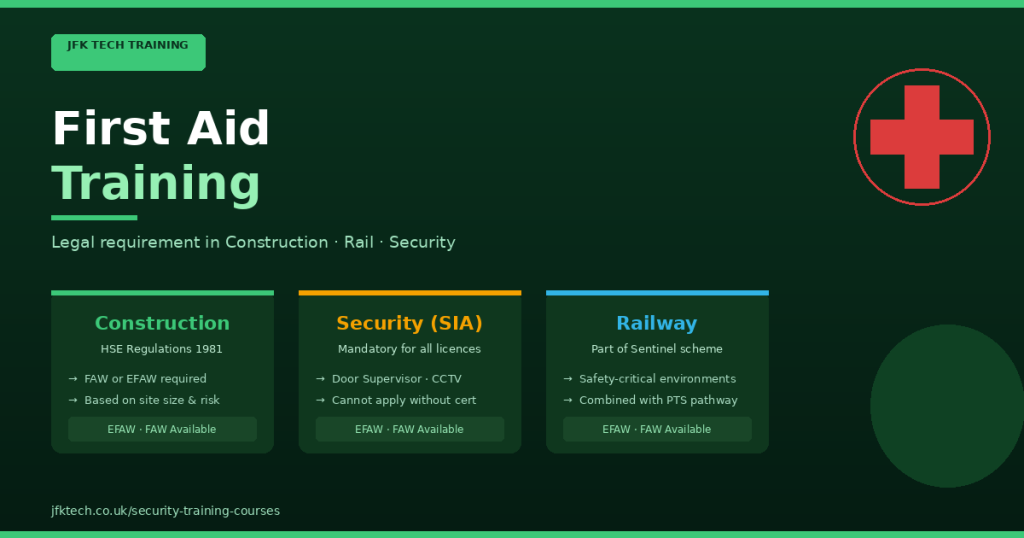
First-aid training is not nice to have. Across the majority of UK work environments, it is a legal requirement. The Health and Safety (First Aid) Regulations 1981 require every employer to ensure adequate first aid provision is in place for their workforce.
For construction sites, the HSE specifies that at least one first aider with a full First Aid at Work (FAW) qualification must be present on sites with significant numbers of workers or high-risk activities. Emergency First Aid at Work (EFAW) certificates are appropriate for smaller, lower-risk sites.
For security professionals, a valid first aid certificate is a mandatory component of every SIA license application. You cannot apply for a door supervisor, CCTV operator, or security guard license without one.
For rail workers, first aid competence is part of the broader safety framework required for Sentinel card registration and site access on certain project types.
JFK Tech Training delivers first aid training as both a standalone course and as part of our broader qualification pathways. You can find our first aid course details on our security training courses.
Further reading: First Aid Training for Construction Sites: Meeting 2026 HSE Compliance Standards
Also useful: How to Conduct a First Aid Needs Assessment for Your London Workplace
Why Choose JFK Tech Training?

There are many training providers in the UK. What separates a good training provider from one that simply takes your money and hands you a certificate is the quality of instruction, the relevance of the content, and the genuine care taken to help each learner succeed.
JFK Tech Training operates from the CEME Innovation Centre at Marsh Way, Rainham, in East London. We are accessible from across Greater London, Essex, and the wider South East. Our trainers are not career educators. They are experienced industry professionals who have worked in the sectors they teach. A trainer who has spent years on construction sites, worked in the rail Experience in the environment or as a security professional provides practical insight that no textbook can replicate.
We offer flexible delivery options, including online SSSTS and SMSTS training for construction professionals who cannot afford to leave the site for extended periods. Our NVQ assessors work around your schedule. We regularly offer our railway and security courses, allowing you to select a date that aligns with your schedule.
We maintain high pass rates across all our training categories through thorough preparation, honest feedback, and trainers who are genuinely invested in helping every learner leave with the certificate they came for.
If you are ready to get started or have questions about which course is right for you, contact our team at 02038085145.
Frequently Asked Questions
Most entry-level courses are open to complete beginners. Some NVQ pathways require existing work experience. Our team will assess your background and recommend the right starting point for you.
Yes. Our online SSSTS and SMSTS courses are fully accessible from any UK location with live trainer sessions. You complete your assessment through our accredited online system at a time that suits you.
Yes. Every person working on or near the line must hold a valid PTS certificate by law. No exceptions apply for contractors, subcontractors, or self-employed workers on Network Rail-managed infrastructure.
SIA license processing typically takes four to eight weeks after submission. Completing your security training and first aid certificate in advance means your application is ready to be submitted without delay.
A gold CSCS card requires an NVQ Level 3 in a relevant construction occupation plus a valid CITB Health and Safety test. JFK Tech Training offers NVQ pathways aligned to every CSCS card category.