
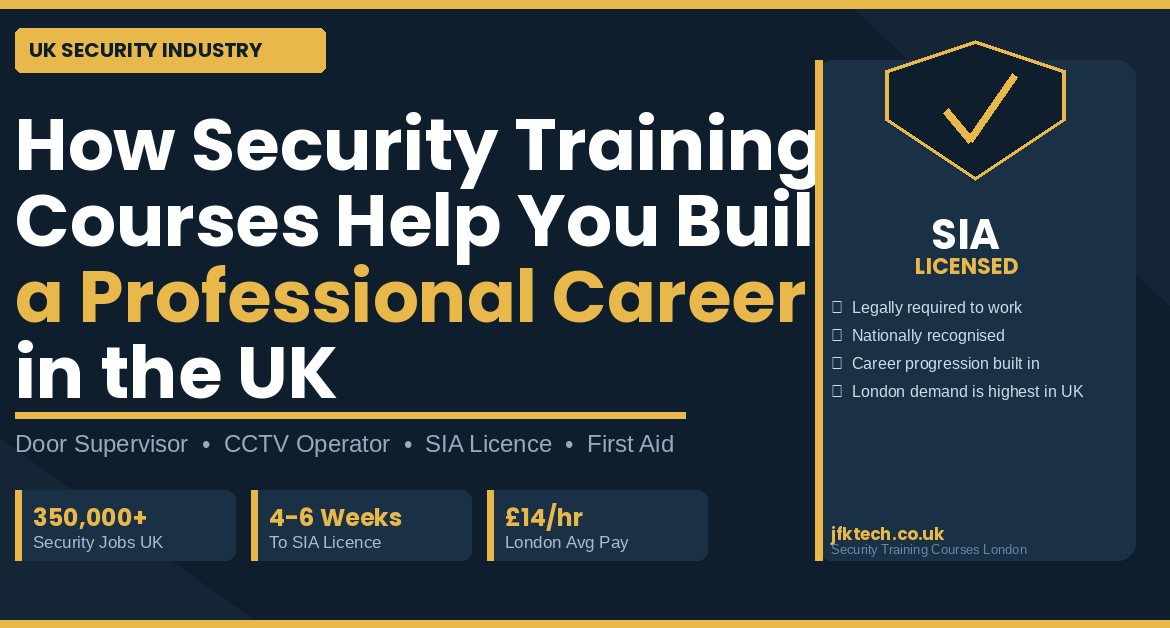
The UK security industry employs over 350,000 people and continues to grow year on year. Demand for trained, licensed security professionals spans retail, hospitality, corporate, events, transport, and public sector environments. If you are considering a career in security — or looking to progress within it — completing the right security training courses is the single most important step you can take.
This guide explains what security training covers, how it leads directly to employment, what career paths open up after qualification, and why London is one of the best places in the UK to train and work in the sector.
The UK Security Industry Needs Qualified Professionals Right Now
Employers across the UK cannot hire unlicensed security staff. The Security Industry Authority (SIA) regulates the entire sector, and every frontline security operative must hold a valid SIA license before they can legally work. That license requires completing an approved training course first.
This creates a clear and direct path: complete your security training, pass your assessment, receive your qualification, apply for your SIA license, and start work. There is no ambiguity and no years of unpaid experience required. The process is structured, achievable, and fast.
For people looking to enter a skilled profession without a university degree or years of prior experience, security training courses in London offer one of the most accessible and reliable routes into sustained, full-time employment available in the UK today.
What Security Training Courses Actually Teach You
Many people assume security work means standing at a door and checking IDs. The reality is considerably more demanding — and considerably more rewarding.
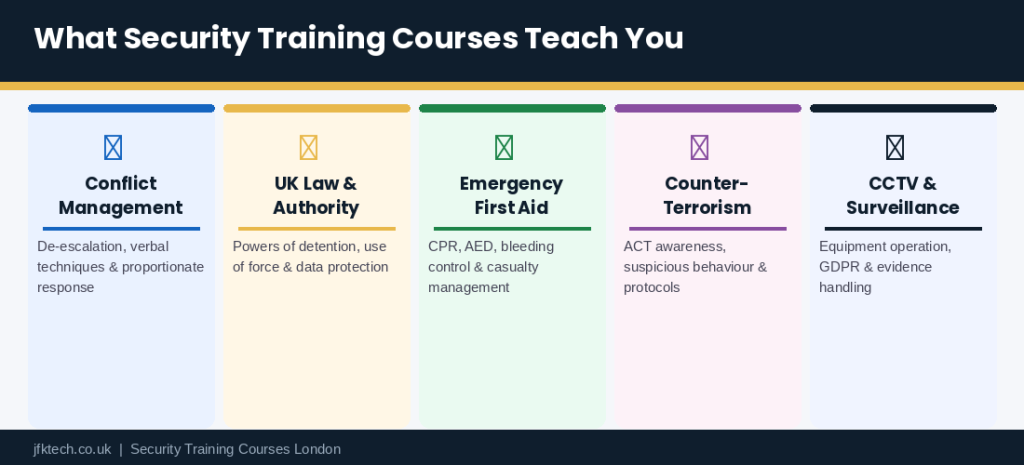
Professional security training builds a broad skill set that applies across dozens of working environments. Here is what structured courses cover in practice:
Conflict Management and De-escalation Security professionals encounter confrontation regularly. Training teaches you how to read situations before they escalate, use verbal communication techniques to defuse tension, and apply physical intervention only when legally justified and proportionate. These skills protect both the operative and the public.
Legal Responsibilities and Powers Every security professional must understand the limits of their legal authority. Training covers the relevant sections of UK law—including the use of reasonable force, powers of detention, data protection obligations for CCTV operators, and the legal framework governing private security work. Operating outside these boundaries carries serious consequences. Training ensures you stay within them.
Emergency response and First Aid Security operatives are often the first responders in an emergency. Whether it is a medical incident, a fire, a violent altercation, or a suspicious package, trained security staff act quickly, correctly, and calmly while emergency services are en route. First aid training is a core component of professional security education.
Counter-Terrorism Awareness The UK security landscape requires every frontline operative to understand the basics of counter-terrorism. This includes recognizing suspicious behavior, responding correctly to a threat, following established protocols, and communicating effectively with law enforcement. The ACT Awareness e-learning program is integrated into current SIA training standards.
Surveillance and CCTV Operation For operatives working in control rooms, transport hubs, retail environments, and public spaces, CCTV training covers equipment operation, legal obligations under the Data Protection Act, incident documentation, evidence handling, and situational awareness techniques.
The Four Core Security Training Courses and Where They Lead
SIA Door Supervisor Training
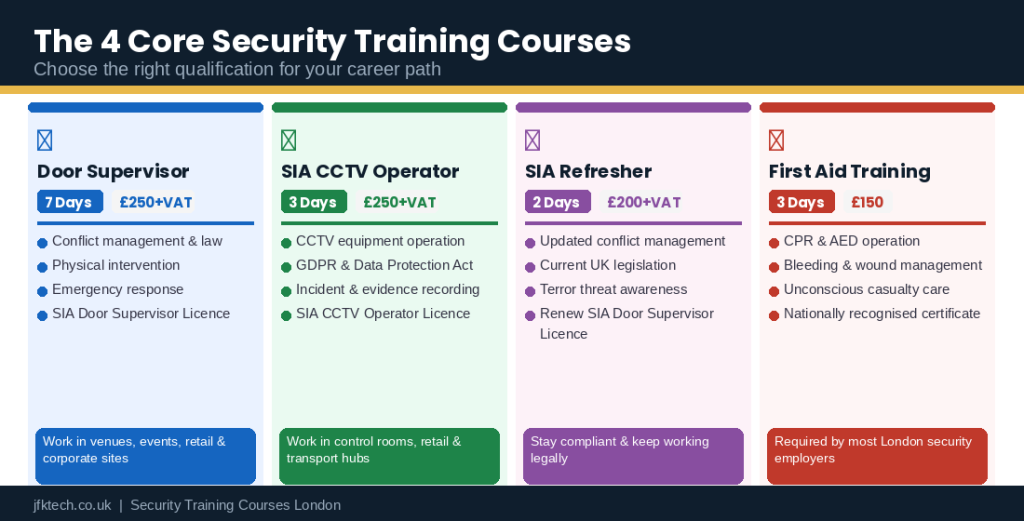
The Door Supervisor course is the most widely recognized qualification in the UK security industry. It covers all of the core competencies listed above—conflict management, legal responsibilities, physical intervention, emergency response, and first aid—across a structured 7-day program.
On completion, you can apply for an SIA Door Supervisor license, which allows you to work legally in pubs, nightclubs, bars, restaurants, hotels, corporate venues, retail environments, and major events. The door supervisor license is one of the most versatile qualifications in the sector—holders work across an enormous range of settings and shift patterns.
Entry-level door supervisors in London typically earn between £11 and £14 per hour. With experience, specialized event work, or supervisory roles, earnings increase substantially.
SIA CCTV Operator Training
The CCTV Operator course runs over 3 days and qualifies you to work as a licensed surveillance operative in control rooms, retail loss prevention teams, transport monitoring centers, and local authority CCTV hubs.
The course covers equipment operation; relevant legislation including GDPR and the Data Protection Act; incident recording; and communication with on-site security teams and police. A CCTV operator license opens doors to steady, full-time employment in environments that operate 24 hours a day, 365 days a year.
CCTV roles suit operatives who prefer a controlled working environment over frontline physical roles. Many experienced security professionals hold both a door supervisor and a CCTV operator license, significantly expanding their employment options.
SIA Refresher Training
If you already hold a door supervisor license, you must complete SIA refresher training before your license expires to continue working legally. The 2-day refresher updates your knowledge across conflict management, physical intervention techniques, current legislation, terror threat awareness, and emergency response protocols.
Letting your license lapse means you cannot legally work in a licensed security role until you reinstate it. Completing refresher training on time protects your income, your professional standing, and your career continuity.
Security training courses in London for refresher qualifications are available year-round, making it straightforward to renew without disrupting your working schedule.
First Aid Training
First Aid certification is both a standalone qualification and a core component of security training across all roles. The 3-day course covers CPR, AED usage, wound and bleeding management, treating shock, and responding to unconscious casualties.
Many employers now require a valid first aid certificate alongside SIA licensing as a baseline employment requirement. Holding this qualification independently also strengthens your CV for supervisory and senior security roles.
How Security Training Courses Open Specific Career Paths
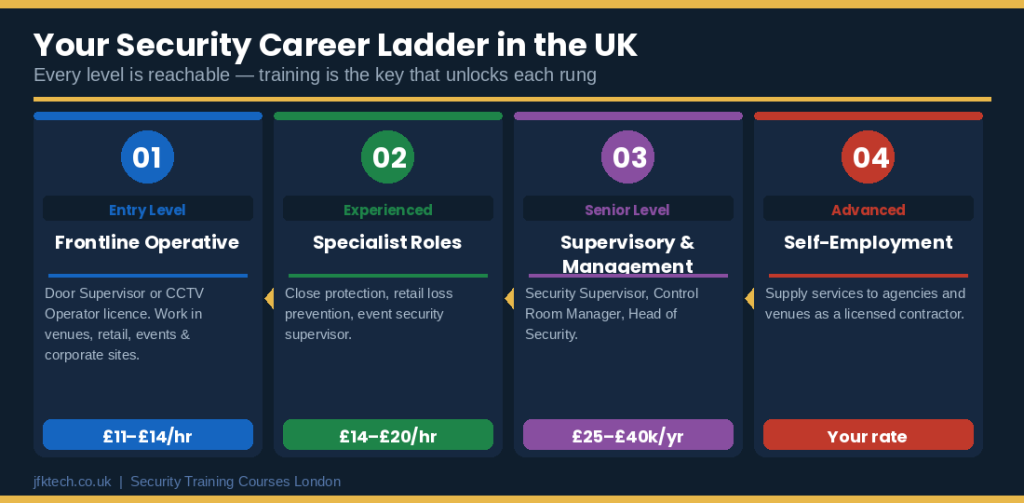
Completing your initial security training is not the end of your professional development — it is the starting point. The UK security sector has a defined career ladder, and each rung requires specific additional qualifications.
Entry Level—Frontline Operative Door Supervisor or CCTV Operator license. Working in venues, retail, events, or control rooms. This is where most security careers begin.
Experienced Operative — Specialist Roles With 2 to 3 years of experience and additional training, operatives move into roles such as close protection (bodyguarding), retail loss prevention specialist, event security supervisor, or corporate security coordinator. Each specialty carries higher pay and increased responsibility.
Supervisory and Management Senior security roles—including Security Supervisor, Control Room Manager, and Head of Security—require a combination of frontline experience, SIA licensing, and often additional management qualifications. Many employers actively promote from within, making this progression achievable for operatives who invest consistently in their training and development.
Self-Employment and Contracting A significant number of experienced security professionals in London operate as self-employed contractors, supplying their services to agencies and venues on flexible terms. This route suits operatives who want control over their schedules and earning potential. Valid SIA licensing is the only non-negotiable requirement.
Why London Is the Right Place to Train and Build Your Security Career
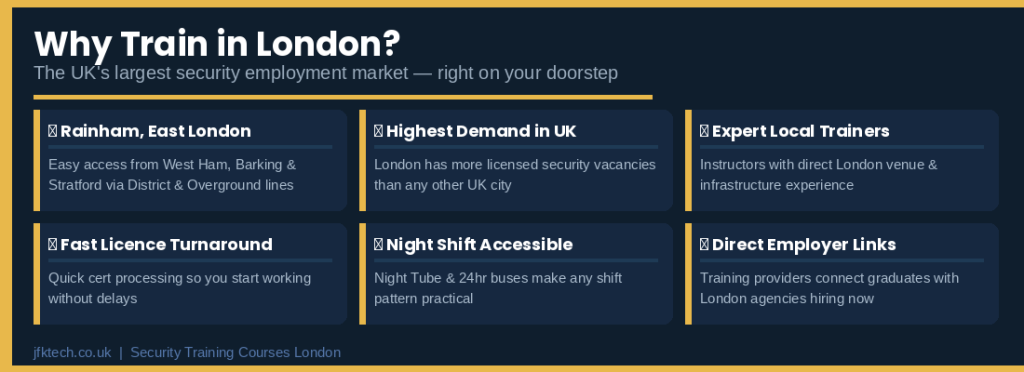
London generates more demand for licensed security professionals than any other city in the UK. The concentration of major venues, corporate headquarters, retail districts, transport infrastructure, sporting arenas, and large-scale events creates consistent, year-round employment across every security specialism.
Training in London gives you direct access to this market from the moment you qualify. Security training courses in London also benefit from instructors who have worked in the city’s specific security environments—understanding the unique demands of London venues, events, and infrastructure projects that operatives from outside the city may not have encountered.
For new entrants, training locally means building networks and relationships with agencies and employers who are actively hiring in your area. Many London-based training providers maintain direct relationships with security employers and can connect qualified graduates with job opportunities immediately after certification.
The city’s public transport network also makes shift work practical in a way that is difficult to replicate elsewhere. Late-night and early-morning shifts—common in door supervision and event security—are accessible via the Night Tube and 24-hour bus network, removing one of the practical barriers that affects security workers in smaller cities.
What to Expect When You Enroll in a Security Training Course
Security training is structured to be accessible for people with no prior experience in the industry. You do not need previous qualifications, a security background, or specialist knowledge to begin.
The process works as follows. You enroll in your chosen course—Door Supervisor, CCTV Operator, First Aid, or Refresher. You attend classroom sessions covering theory, law, and scenario-based learning. You complete practical assessments covering the physical and procedural skills relevant to your role. On successful completion, you receive your qualification certificate.
From there, you apply to the SIA for your license. The SIA processes applications and issues licenses to qualified candidates who pass their identity and background checks. Once your license arrives, you are legally cleared to work.
The timeline from enrollment to first shift varies, but most candidates complete training and receive their SIA license within four to six weeks of starting.
Start building your security career today.
Security training courses give you a licensed, respected, and in-demand qualification that opens doors to consistent employment across one of the UK’s largest and most stable industries. Whether you are starting from scratch, renewing an existing license, or expanding your qualifications into CCTV or first aid, completing the right training is the foundation everything else is built on.
Frequently Asked Questions
No prior experience is required. Security training courses are designed for complete beginners. You need to meet the SIA’s basic eligibility criteria, including a right to work in the UK and a satisfactory background check.
Most candidates receive their SIA license within three to five weeks of submitting their application after completing training. Processing times can vary slightly depending on application volumes at the time.
Yes. Many providers offer weekend and evening course schedules specifically to accommodate people who are currently employed and need to train around existing work commitments without losing income.
Yes. An SIA door supervisor license is nationally recognized and allows you to work legally in licensed security roles anywhere in England, Wales, Scotland, and Northern Ireland without any additional regional certification.
A door supervisor license covers both static guarding and physical intervention roles, making it more versatile. A security guard license covers static guarding only. Most employers and agencies in London prefer or require the Door Supervisor qualification for frontline roles.