Introduction
If you are preparing for your CPCS Traffic Marshall A73 test, you are already doing the right thing by researching early. The test is straightforward when you know what to expect—but candidates who walk in underprepared consistently struggle with the same avoidable mistakes.
This guide covers everything you need to know: what the CPCS A73 test includes, how to prepare for both the theory and practical sections, which hand signals you must master, and what to do on the day itself. Follow this step-by-step, and you give yourself every chance of passing the first time.
What’s the CPCS Traffic Marshall A73 test?
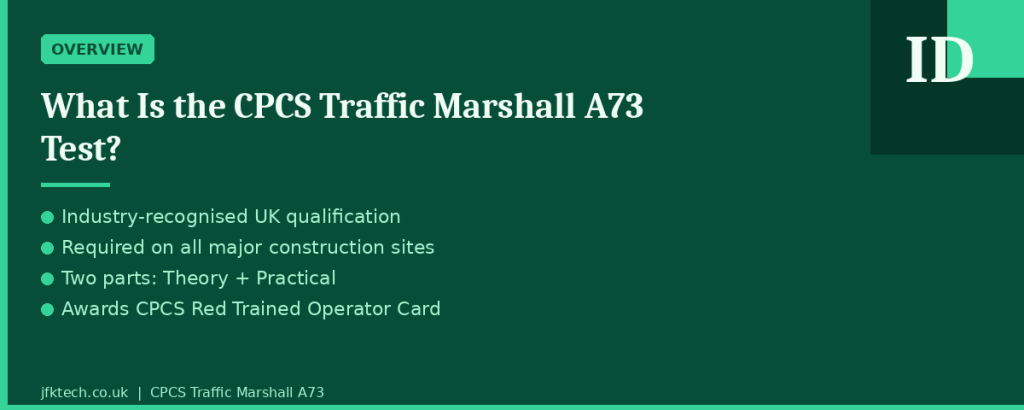
The CPCS Traffic Marshall A73 is the industry-recognized qualification for anyone responsible for directing vehicles safely on UK construction sites. CPCS stands for Construction Plant Competence Scheme — the gold standard for plant and site operative certifications across the UK.
If you work on a construction site in London or anywhere else in the UK, your employer almost certainly requires you to hold this card before you take on a marshalling role. The test splits into two parts: a theory assessment and a practical demonstration. Pass both, and you receive your CPCS Red Trained Operator Card.
What Does the CPCS A73 Test Actually Cover?
Before you start preparing, you need to know exactly what the examiner tests you on. The CPCS A73 assessment covers these core areas:
- Legal responsibilities under the Health & Safety at Work Act
- Correct CPCS-approved hand signals for directing vehicles
- Vehicle blind spots and safe exclusion zones
- Pedestrian-plant separation and site safety rules
- Communication with plant operators and site supervisors
- Required PPE and high-visibility positioning
- Managing vehicle flow during peak site activity
- Practical maneuvers—reversing, loading, tight-space guidance
The theory section tests your understanding through written or verbal questions. The practical section requires you to demonstrate real marshalling skills in a simulated or live environment.
Step-by-Step: How to Prepare for the CPCS A73 Test
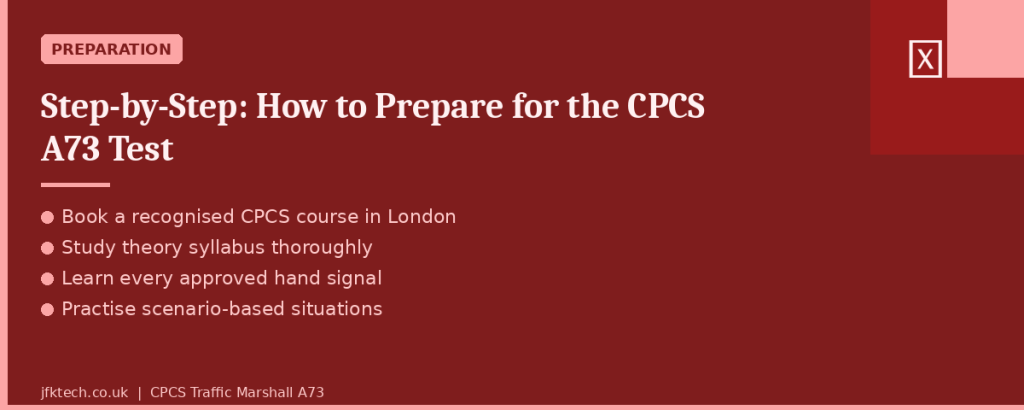
Candidates who fail their first attempt almost always underestimate the practical side. Here is exactly how to prepare properly.
Book a Recognised CPCS Traffic Marshall Course in London
You cannot sit for the CPCS A73 test without completing formal training first. Enroll in a CPCS Traffic Marshall course in London delivered by approved instructors. This ensures you learn the correct standards—not shortcuts that will catch you out on test day, which could lead to failing the test and delaying your ability to work as a Traffic Marshall.
Study the CPCS A73 Theory Syllabus Thoroughly
The theory exam covers legislation, hazard identification, and marshalling procedures. Read through the Health & Safety at Work Act 1974, the Provision and Use of Work Equipment Regulations (PUWER), and the CPCS technical test revision guide for the A73 category.
Learn Every Approved CPCS Hand Signal — No Guessing
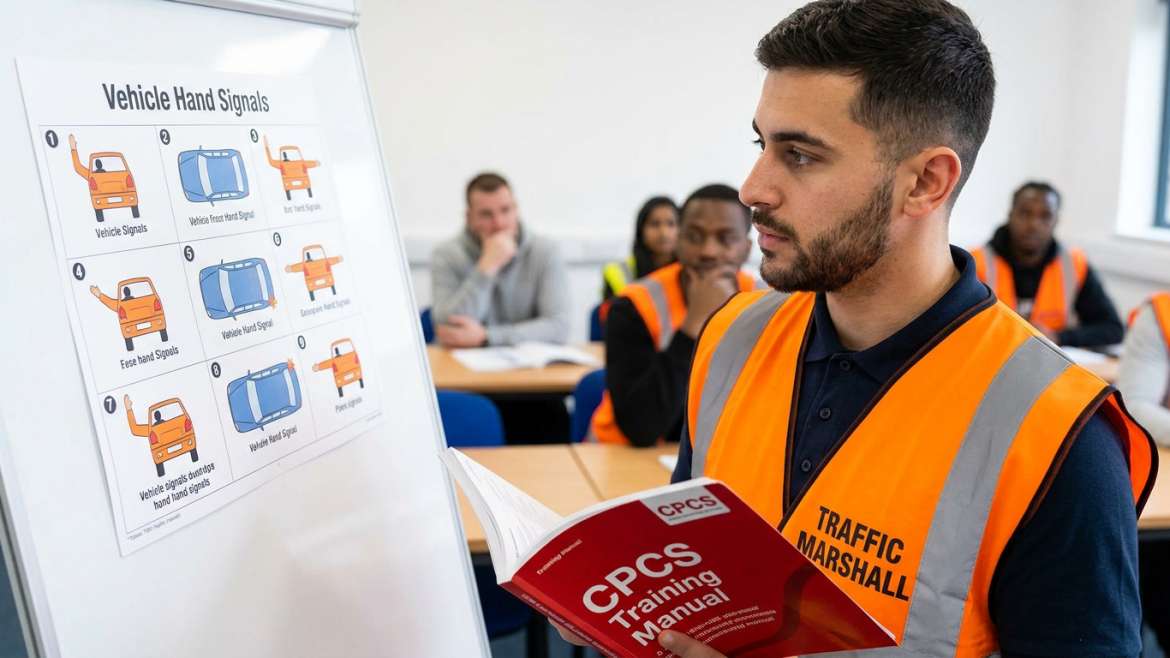
Hand signals are the most heavily assessed part of the practical test. You must demonstrate each signal clearly, confidently, and in the correct sequence. Practice in front of a mirror or with a colleague until every movement is automatic.
Understand Blind Spots for Every Common Site Vehicle
Examiners ask specifically about the blind spots of dumpers, telehandlers, lorries, and excavators. You must know where the operator cannot see and position yourself accordingly.
Practice Scenario-Based Situations Out Loud
Walk through scenarios like guiding a reversing lorry into a tight bay, stopping a vehicle safely, and managing two vehicles crossing paths. Verbalize your thought process. Examiners want to see that you think before you act.
Prepare Your PPE the Night Before
Turn up with the right gear: safety boots, a high-vis vest, a hard hat, and gloves. Arriving without PPE causes unnecessary stress and immediately tells the examiner you are not site-ready.
Master the CPCS-Approved Hand Signals
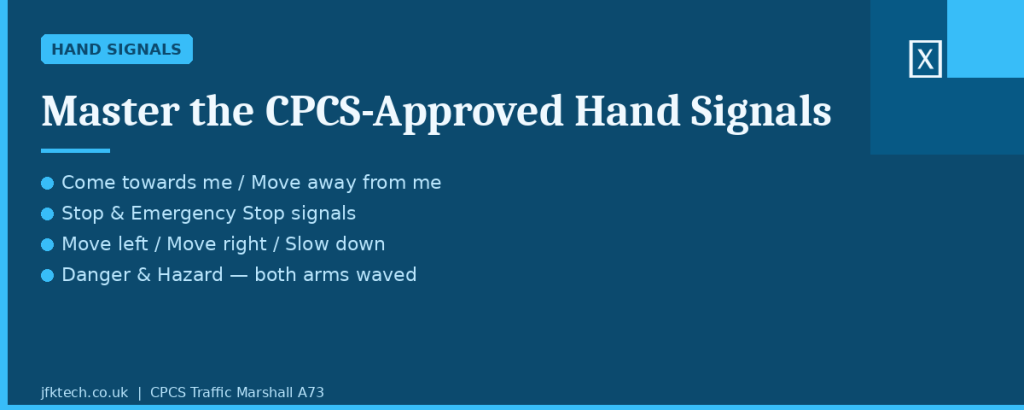
This is where most candidates lose marks. The CPCS A73 test requires you to use standardized CPCS-approved hand signals—not the informal ones you might have picked up on site. There is a difference, and examiners know it.
Core Hand Signals You Must Know
- Come towards me—arms extended, palms inward, beckoning motion
- Move away from me—both arms extended, palms outward, pushing away
- Stop—one arm raised vertically, palm forward, held firm
- Emergency stop — both arms raised, crossed at the wrists above the head
- Move left / Move right—arm extended, pointing in direction of travel
- Slow down—one arm extended horizontally, palm down, gentle up-and-down motion
- Danger / Hazard — both arms waved above the head rapidly
Practice each signal at full arm extension, clearly and deliberately. On the day, small hesitant movements look uncertain. Examiners reward clarity and confidence above all else.
Common Mistakes That Cause Failures
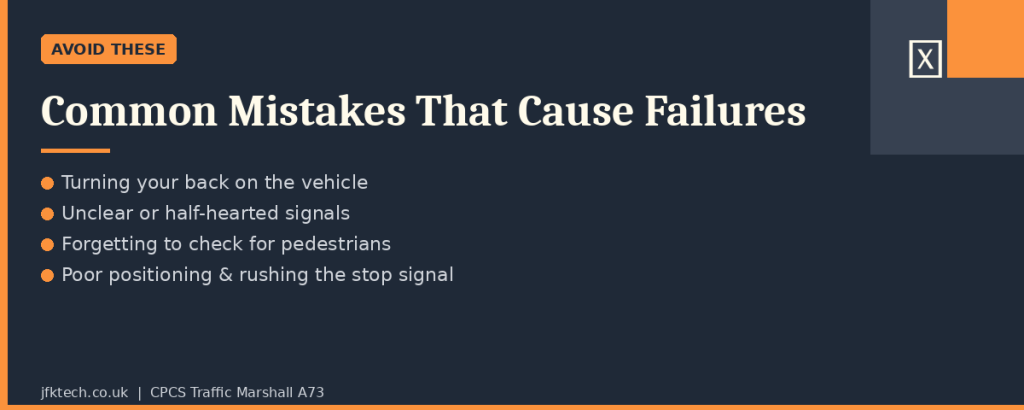
After training hundreds of candidates across our CPCS courses in London, our instructors consistently see the same avoidable errors:
Mistake 1: Turning your back on the vehicle. You must maintain eye contact with the driver and the vehicle at all times. Never turn away, even briefly. Such an error is an automatic fail in most assessments.
Mistake 2: Giving unclear or half-hearted signals. A signal the driver cannot clearly read is a dangerous signal. Make every movement deliberate and large and hold it until the driver acknowledges it.
Mistake 3: Forgetting to check for pedestrians. Before any vehicle movement, visually sweep the area for pedestrians and other hazards. Examiners specifically watch for this step.
Mistake 4: Poor positioning. Stand where the driver can always see you and where you can see the full vehicle path. Standing too close, too far, or in the vehicle’s blind spot fails the practical immediately.
Mistake 5: Rushing the stop signal. When you give the stop signal, hold it firmly until the vehicle comes to a complete standstill. Dropping your arm early suggests the vehicle might still move—examiners penalize this.
What to Expect on Test Day
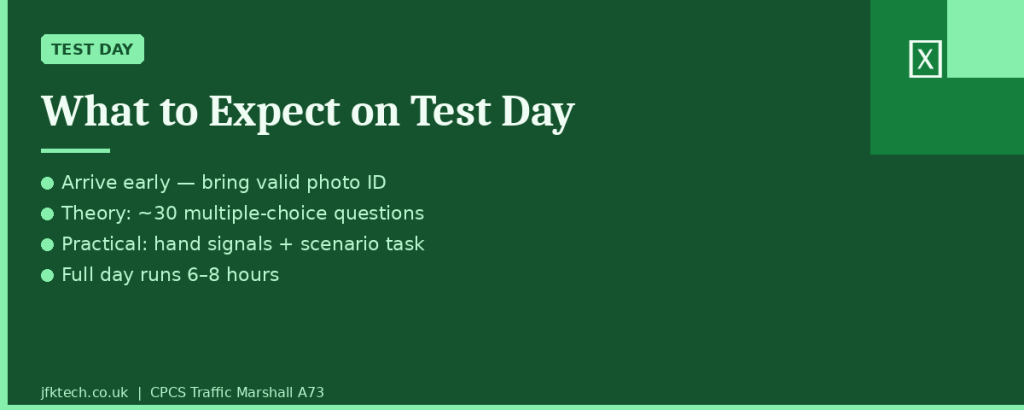
Knowing what the day looks like removes a lot of the anxiety. Here is how a typical CPCS Traffic Marshall A73 assessment day runs:
- Arrive early, sign in, and confirm your ID with the test center
- Attend a brief introduction from the assessor covering the day’s structure
- Complete the theory assessment—multiple choice questions on legislation, safety, and procedure
- Take a short break while results are reviewed
- Move to the practical assessment area to demonstrate hand signals and vehicle guidance
- Complete a scenario exercise—typically a reversing or manoeuvring task
- Receive feedback from the assessor and, if successful, confirmation of your CPCS result
The full day typically runs between 6 and 8 hours. Stay calm, work methodically, and trust the preparation you have put in.
What Happens After You Pass?
Once you pass both the theory and practical components of the CPCS Traffic Marshall A73 assessment, you receive your CPCS Red Trained Operator Card. This card:
- Is valid for 2 years from your test date
- Is recognised by all major UK construction employers and contractors
- Confirms your competence to manage vehicle movements on UK construction sites
- Can be upgraded to a CPCS Blue Competence Card after completing an NVQ assessment
The Blue Card is the long-term goal for most candidates. You can start working toward your NVQ qualification while you work under your red card to build up the required evidence portfolio.
Related Training at JFK Tech
→ Security Training Courses London
Conclusion
Passing the CPCS Traffic Marshall A73 test on your first attempt becomes much easier when you understand the process and prepare methodically. By studying the theory syllabus, practicing the approved hand signals, and understanding vehicle blind spots and site safety procedures, you build the confidence needed for both the written and practical assessments.
Most importantly, treat the role of a CPCS traffic marshall as a serious safety responsibility. The training and assessment are designed to ensure that you can guide vehicles safely, protect pedestrians, and maintain order on busy construction sites. With the right preparation, attention to detail, and consistent practice, you can approach the test confidently and take the first step toward a successful career in construction site safety.
Frequently Asked Questions
No prior experience is required. The CPCS Traffic Marshall A73 course is fully open to beginners. Your instructor covers everything from the ground up — legal responsibilities, hand signals, vehicle hazards, and practical technique. Many candidates complete it with zero prior site experience and pass the first time.
The CPCS A73 theory test typically includes around 30 multiple-choice questions covering site safety, legislation, vehicle hazards, and marshalling procedures. Your training course will cover all topic areas, and your instructor will run you through practice questions before the real assessment.
The CPCS Red Trained Operator Card is what you receive after passing your A73 test. It confirms you have completed formal training and assessment. The CPCS Blue Competence Card is the next step — you earn it after completing an NVQ in your category, which demonstrates real on-site competence built over time.
Yes, you can retake the CPCS A73 assessment. Your assessor will provide feedback on exactly which areas you need to improve before rebooking. Most candidates who fail the first time pass on their second attempt once they focus on the specific areas flagged. A refresher session with your training provider is strongly recommended before a resit.
Yes. While the CPCS Traffic Marshall A73 qualification is primarily associated with construction, the skills transfer directly to event management, logistics hubs, loading bays, car parks, and security operations. Many employers in these sectors actively seek candidates with formal traffic marshalling certification.