
If you work in plant operations or you are about to start, you have probably come across two acronyms more than any others: CPCS and NPORS. Both are operator cards. Both prove you have been assessed on a specific machine. But they are not the same thing, and choosing the wrong one can mean turning up to a site and being turned away at the gate.
This guide cuts through the confusion. We explain what each card does, where it is accepted, what the process looks like, and how to decide which one actually fits your situation. No jargon, no filler, just the information you need to make the right call.
What Are CPCS and NPORS?
Before comparing them, it helps to understand what each scheme is actually designed to do.
CPCS: Construction Plant Competence Scheme
CPCS is run by CITB (the Construction Industry Training Board). It is the older of the two schemes and was built specifically for plant operators. When you complete your CPCS training and pass the theory and practical assessments, you receive a card that is directly linked to the CSCS scheme, the card system used across almost every major UK construction site. CPCS cards feed into the CSCS database, which is what site managers check when they scan your card at the gate.
NPORS — National Plant Operators Registration Scheme
NPORS is an independent scheme managed by the Association of Industrial Truck Trainers (AITT). It was created to offer a more flexible, cost-effective route to operator competence and is widely used across sectors like haulage, waste management, utilities, and manufacturing — not just construction. NPORS offers two types of cards: a standard NPORS card and an NPORS card with a CSCS logo (sometimes called the NPORS CSCS card).
Key Differences at a Glance
On the surface, both cards look similar. They both state the machine category you are trained on, they both have an expiry date, and they both show your personal details. But underneath, there are real differences that matter for your career.
CPCS vs. NPORS—Which Card Is Right for You?
Choosing between CPCS and NPORS comes down to five key factors. Here is how they compare:
CSCS Acceptance
CPCS: Automatically accepted. CPCS is directly linked to the CSCS scheme, so your card works on virtually every UK construction site without question.
NPORS: Conditionally accepted. Only the NPORS CSCS logo card version is recognized on CSCS sites. The standard NPORS card is not always accepted.
Test Required
CPCS: You must pass the CITB Health, Safety, and Environment Test before applying.
NPORS: No test is required for the standard card. However, if you want the NPORS CSCS logo version, the CITB test is needed.
NVQ Required?
CPCS: An NVQ is required if you want to upgrade to the Blue (competent operator) card.
NPORS: An NVQ is only required for the NPORS CSCS logo competent card upgrade.
The Red vs Blue Card — Why It Matters
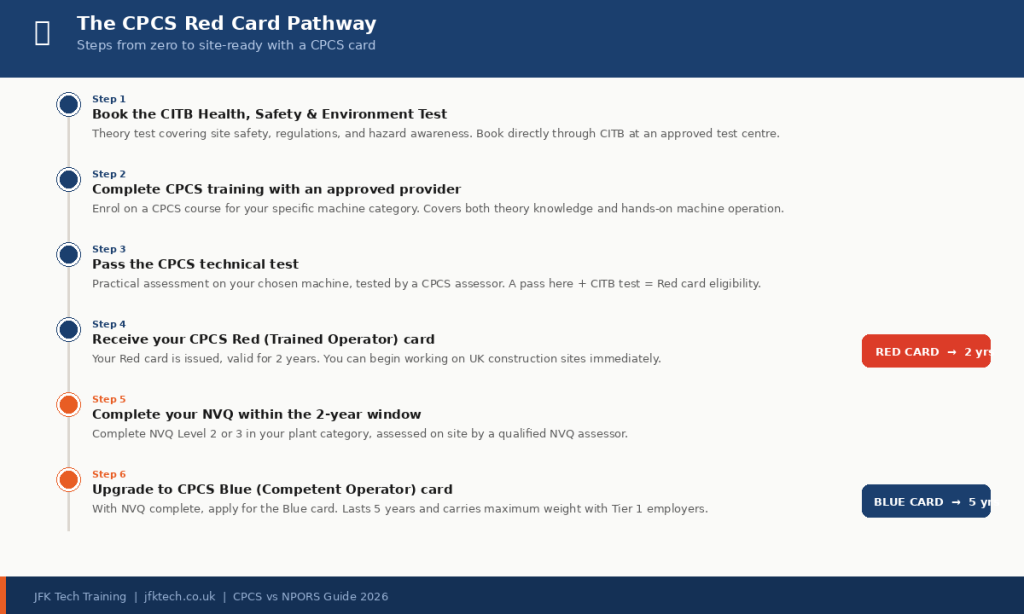
CPCS runs on a two-stage card system. The Red (Trained Operator) card is for people who have passed the theory and practical test but have not yet completed their NVQ. It is valid for two years and acts as a starter card. The Blue (Competent Operator) card is the full qualification — you get it once you complete the relevant NVQ, and it lasts five years. Most major UK construction projects, especially those involving large principal contractors, require a Blue card as a minimum.
NPORS mirrors this with Category A (trained) and Category B (competent), with the Category B card requiring NVQ completion and carrying the CSCS logo.
What CSCS Actually Checks
When a site manager or security operative scans your card at a UK construction site, the scanner queries the CSCS database. That database holds records from multiple card schemes—CPCS cards are in there automatically. NPORS cards with the CSCS logo are also in the database, but only if the cardholder completed the full route, including the CITB Health, Safety & Environment test and relevant NVQ. Standard NPORS cards without the CSCS logo are not in the CSCS database.
This is not a detail you want to discover at 07:30 on a Monday morning at the site entrance.
How to Get Each Card
Step 1: Book the CITB Health, Safety & Environment Test
This is a theory test covering site safety, regulations, and hazard awareness. You book it directly through CITB and take it at an approved test center. You need a pass result before your CPCS application is processed.
Step 2: Complete CPCS training with an approved provider
Enroll in a CPCS course for your specific machine category—excavator, dumper, telehandler, crane, and so on. Training covers both theory knowledge and hands-on machine operation with a qualified CPCS assessor.
Step 3: Pass the CPCS technical test
This is the practical assessment on your chosen machine. The assessor tests your ability to operate safely and competently to the CPCS standard for your category. A pass here, combined with your CITB test, qualifies you for the red card.
Step 4: Receive your CPCS Red (Trained Operator) card
Your red card is issued and valid for two years. You can begin working on site immediately. During this period, you will need to log on-site hours in your machine category.
Step 5: Complete your NVQ (within the 2-year window)
To progress from Red to Blue, you must complete the relevant NVQ Level 2 or Level 3 in your plant category, assessed on site by a qualified NVQ assessor. This demonstrates sustained competence in real working conditions.
Step 6: Upgrade to CPCS Blue (Competent Operator) card
With your NVQ complete, you apply for the blue card. It lasts five years, carries more weight with employers and principal contractors, and marks you as a fully qualified plant operator
One practical point: if you already work for a company that uses NPORS across its fleet, perhaps in plant hire, utilities, or groundwork setting, the standard NPORS route may be all you need and significantly cheaper. If you are aiming specifically at large UK construction projects with principal contractors requiring CSCS gate scanning, either CPCS or the NPORS CSCS logo route is the safer choice.
You can find out more about the full range of CPCS courses at JFK Tech Training, including individual machine categories, course durations, and pricing.
Conclusion
At the end of the day, both CPCS and NPORS are respected qualifications; the right one simply depends on where you want to work and how far you want to go. If your goal is large UK construction sites with principal contractors, go CPCS. If you need flexibility across multiple industries or want a more affordable starting point, NPORS delivers that. Either way, the worst decision you can make is turning up to a site without the right card in your wallet. At JFK Tech Training in London, we offer the full range of CPCS courses across all major machine categories, from excavators and dumpers to telehandlers and cranes.
Frequently Asked Questions
Only the NPORS CSCS logo card is accepted. The standard NPORS card is not registered in the CSCS database and will not be recognised at a gate scanner.
CPCS requires a mandatory CITB Health, Safety, and Environment test upfront. The NPORS standard card skips this test, making it more accessible—especially for non-construction sectors.
Most people receive their red card within three to four weeks. This includes the CITB test, practical training, assessment, and card application processing time.
You must complete your NVQ within the two-year validity window to upgrade to Blue. If it expires before that, you may need to reapply and retest.
First aid is not mandatory for the CPCS card itself. However, most UK construction sites require an EFAW certificate as a site entry condition. Get both together.