Whether you’re a complete beginner looking to break into the security industry or a seasoned professional wanting to sharpen your skills, one of the first questions you’ll ask is, “How much does a security training course actually cost?” The answer isn’t a single number — it depends on the type of course, your career goals, the certifications involved, and the format of delivery. This guide breaks it all down so you can make a smart, informed decision in 2026.
Why Security Training Is More Important Than Ever in 2026
Cyber threats, workplace violence, data breaches, and physical security risks have grown more sophisticated in recent years. Employers across industries from retail and healthcare to banking and government now demand that security personnel hold verified credentials. Beyond compliance, proper training directly impacts how effectively a security professional can respond to real-world situations.
This rising demand has created a booming market for security training, and with that comes a wide range of price points, quality levels, and course formats. Knowing what you’re paying for is half the battle.
Types of Security Training Courses and Their Costs
Security training is not one-size-fits-all. Here’s a breakdown of the most common categories and what they typically cost in 2026.
1. Basic Security Guard Training (Entry-Level)
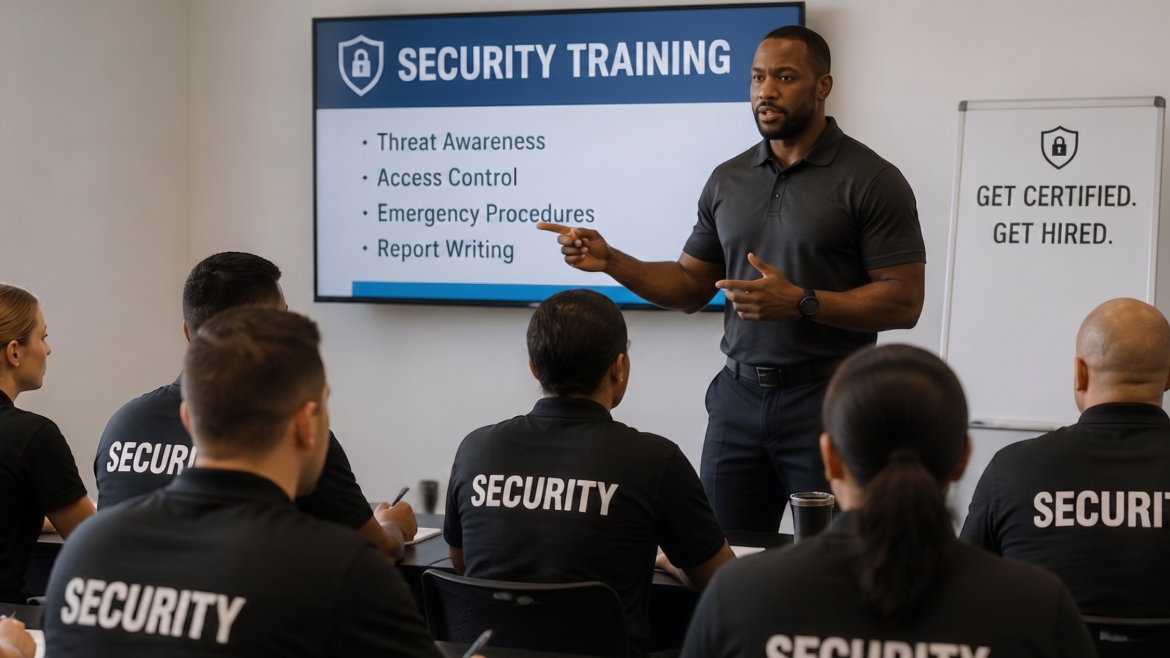
For individuals entering the security training courses field for the first time, state-mandated security guard licensing courses are the starting point. These programs cover topics like legal powers of arrest, emergency procedures, patrol techniques, and report writing.
Typical cost: $100 – $400
These courses are often completed in 8 to 40 hours depending on state requirements. Online options have made this more affordable, with some providers offering basic packages under $150. In-person classroom training with hands-on components tends to sit at the higher end.
2. Cybersecurity Training Courses
Cybersecurity is one of the fastest-growing and highest-paid sectors in security. Training in this space covers areas like ethical hacking, network defense, incident response, and cloud security.
Typical cost: $300 – $5,000+
The range is enormous because cybersecurity training spans from short introductory courses (available on platforms like Coursera or Udemy for under $50 during promotions) to intensive bootcamps costing $5,000 or more. Many professionals pursue certifications like CompTIA Security+, CEH (Certified Ethical Hacker), or CISSP, each of which carries its own exam and prep course fees.
3. Corporate Security and Loss Prevention Training
Designed for professionals working in asset protection, loss prevention management, or corporate security roles, these programs address risk assessment, surveillance, investigations, and crisis management.
Typical cost: $500 – $3,000
These courses are often offered by industry associations such as ASIS International, whose certifications (CPP, PSP, PCI) are considered gold standards in the field. Membership with ASIS can reduce exam and course fees significantly.
4. Executive Protection and Close Protection Training
Training for bodyguards and executive protection agents is among the most specialized and most expensive in the industry. Programs cover threat assessment, secure transportation, defensive driving, and emergency medical response.
Typical cost: $1,500 – $10,000
Top-tier residential programs can exceed $10,000 and last several weeks. They include live scenario training, weapons handling (where legally permitted), and hands-on protective detail exercises. Quality varies widely, so researching accreditation and instructor credentials is essential.
5. First Aid, CPR, and Emergency Response (Security Add-Ons)
Many security roles require first aid or CPR certification as a supplement to primary training. These are short courses, typically one to two days and are often required for license renewal.
Typical cost: $50 – $200
Organizations like the Red Cross and St. John Ambulance offer these widely. Employers frequently subsidize or fully cover this cost.
Read more: How Security Training Courses Help You Build a Professional Career in the UK
What Factors Affect the Price of a Security Training Course?
Understanding why prices vary so much helps you avoid overpaying—or underpaying for poor quality.
Delivery format is one of the biggest cost drivers. In-person, instructor-led training almost always costs more than self-paced online courses. However, some roles legally require in-person components.
Certification included raises the price considerably. A course that includes the certification exam fee bundled in is worth more than one that does not. Always check whether the exam voucher is included.
Accreditation and recognition matter. A course accredited by a recognized body — whether a state licensing board, ASIS International, CompTIA, or ISC² — carries more professional weight and often more quality assurance. These courses tend to cost more, but they’re worth it.
Instructor experience plays a role too. Programs led by former law enforcement, military, or senior cybersecurity professionals typically price themselves higher — and often deliver more practical, real-world value.
Location affects cost for in-person training. Courses in major cities like New York, Los Angeles, or Chicago tend to run higher than those in smaller markets. Many professionals now sidestep this entirely with remote learning.
Is a More Expensive Course Always Better?
Not necessarily. A $3,000 cybersecurity bootcamp from an unaccredited provider may deliver less value than a $400 self-paced CompTIA Security+ prep course paired with the $392 exam voucher. The key is to look at outcomes — job placement rates, employer recognition, and what credentials you walk away with.
That said, for hands-on roles like executive protection or tactical security, in-person training with qualified instructors genuinely cannot be replaced by a cheap online alternative. In those cases, spending more often means learning more.
How to Get the Best Value in 2026
Getting the most from your training budget comes down to a few smart strategies.
First, confirm what your employer or state requires before spending a dollar. Some states mandate specific courses for licensing, and your employer may reimburse approved training.
Second, look for bundle deals. Many platforms offer course + exam voucher bundles that save 20–30% over purchasing separately.
Third, check for employer sponsorship. Corporate security, healthcare, and government sectors frequently fund or subsidize professional development for their staff.
Finally, consider the return on investment. A certified security professional in cybersecurity earns significantly more than one without credentials. Spending $1,000 on a course that earns you a $15,000 salary increase pays for itself quickly.
Final Thoughts
Security training course costs in 2026 range from under $100 for a basic guard license course to over $10,000 for elite executive protection programs. The right amount to pay depends entirely on your career goals, current experience level, and the role you’re targeting. Focus on accreditation, real-world outcomes, and whether the credential is recognized by employers in your field, not just the price tag.
Investing wisely in your security education today is one of the most reliable ways to advance your career, boost your earning potential, and operate with greater confidence on the job.
Frequently Asked Questions
A basic security guard training course typically costs between $100 and $400, depending on your state’s requirements and whether the course is online or in-person. Some states require as few as 8 hours of training, while others mandate 40+ hours.
Yes, for most people, cybersecurity training offers an excellent return on investment. Entry-level certifications like CompTIA Security+ can increase starting salaries by thousands of dollars per year. More advanced certifications like CISSP or CEH open doors to high-paying roles in enterprise security and consulting.
Yes, to a limited extent. Platforms like Cybrary, SANS Cyber Aces, and Google’s Cybersecurity Certificate on Coursera offer free or heavily subsidized content. However, free courses typically do not include certification exams, which often carry separate fees ranging from $200 to $700.
Not always, but many employers, especially in corporate, government, and healthcare sectors—offer tuition reimbursement or training stipends for role-related courses. Always ask your HR department before paying out of pocket.
Most security certifications require renewal every 2 to 3 years. For example, CompTIA Security+ requires renewal every three years through continuing education credits or re-examination. State security guard licenses often require annual or biennial renewal, sometimes including refresher training.