
Whether you’re just starting out or aiming to transition from a laborer role to a supervisor position, it’s crucial to understand which certifications hold the most value for UK employers. This guide covers the five most sought-after construction certifications in 2026, what they entail, who they are for, and how to begin accredited construction courses in the UK.
We also cover a bonus certification that most candidates overlook—and show you exactly how to combine these qualifications to maximize your earning potential in construction courses in London and across the country.
CSCS Card — The Non-Negotiable Entry Ticket
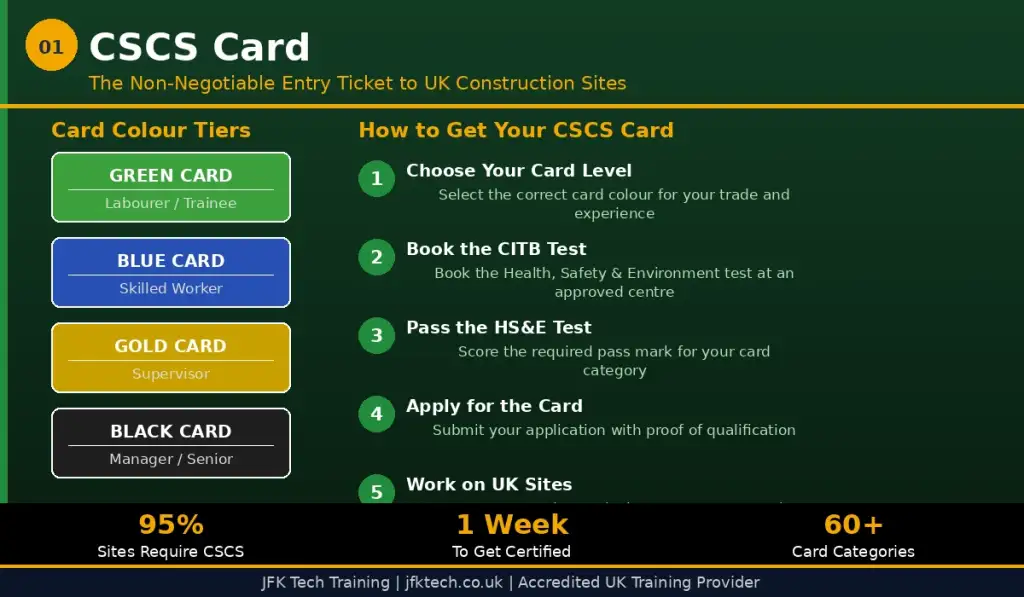
Ask any UK site manager what the first thing they check is when a new worker arrives, and the answer is almost always the same: Do you have your CSCS card? The Construction Skills Certification Scheme card is the baseline requirement across virtually every construction site in England, Scotland, Wales, and Northern Ireland. Without it, you simply do not get past the site gate.
The card proves that you hold the relevant health and safety knowledge and qualifications for your specific trade or role. There are different card colors depending on your experience and qualification level. A green card is for laborers who have passed the CITB Health, Safety, and Environment test. A blue card applies to skilled workers. A gold card is for supervisors, and a black card is reserved for managers.
Who needs a CSCS card?
Quite simply, everyone on site. Whether you are a bricklayer, electrician, scaffolder, plasterer, or laborer, you will almost certainly need a CSCS card before you step foot on any commercial construction project in 2026. Most principal contractors now make it a stringent requirement in their site rules, and many public sector projects will not allow entry without one.
How do you get one?
You need to pass the CITB Health, Safety, and Environment (HS&E) test, which you can book at an approved test center. Many candidates who take our accredited construction courses in London use their training to prepare for this test and get their card sorted in the same week. The whole process is straightforward once you know what to study and which card color applies to your trade.
Getting your CSCS card is the single most important first step you can take if you are serious about working in UK construction. Explore our full range of construction courses to find the best preparation pathway for your specific trade and experience level.
SMSTS — The Gold Standard for Site Managers
If you want to manage a construction site in the UK, the Site Management Safety Training Scheme certificate is one of the most respected qualifications you can hold. Delivered over five days and assessed through written tests and group exercises, SMSTS trains you in health and safety legislation, risk assessment, CDM regulations, and your legal responsibilities as a site manager.
UK employers, particularly major contractors and principal contractors, now treat SMSTS as an essential requirement for anyone managing site operations. It is not a luxury to have. It is expected. Many contracts and public sector projects specifically require the site manager to hold a valid SMSTS certificate before any work can begin on site.
Why is SMSTS so valuable in 2026?
The construction industry has faced increased scrutiny around health and safety compliance recently. The HSE has significantly tightened enforcement, imposing serious fines on employers whose sites fail to comply. As a result, employers actively seek SMSTS-certified managers because they reduce legal risk and demonstrate competence at the very highest level.
Higher earnings directly correlate with an SMSTS certificate. Research consistently shows that site managers with SMSTS certification earn significantly more than those without it. The pay gap between certified and uncertified managers in UK construction continues to widen year over year, making this one of the highest-return qualifications available.
How long does the SMSTS certificate last?
The certificate is valid for five years. Thereafter, you complete a two-day refresher course to keep it current. You can explore our accredited construction training courses in London to find out how to enroll for SMSTS training near you and fast-track your path into a site management career.
SSSTS — The Essential Qualification for Supervisors
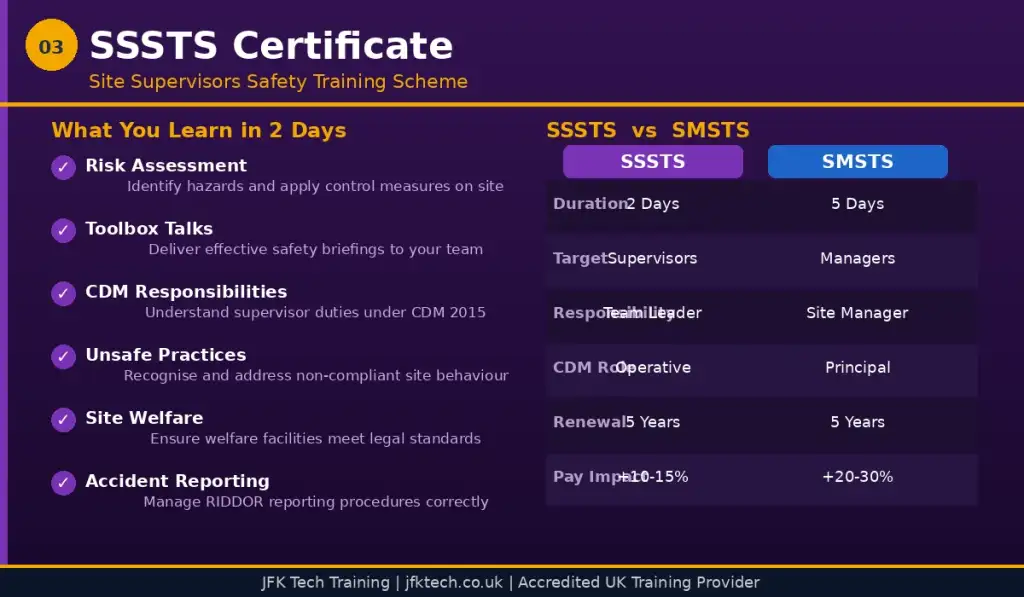
Not quite at manager level yet? The Site Supervisors’ Safety Training Scheme certificate is the natural stepping stone. Completed over two days, SSSTS covers the key principles of health and safety management tailored specifically for supervisors and team leaders — people who are on the tools but also responsible for leading a small team every single day.
SSSTS teaches you how to conduct risk assessments, deliver toolbox talks, manage CDM responsibilities at a supervisory level, and identify and address unsafe working practices on site. These are practical, hands-on skills that employers need present on every project, no matter the size.
SSSTS vs SMSTS—which one do you actually need?
This is one of the most common questions we get from people exploring construction courses in London and across the UK. The simple answer is as follows: choose SSSTS if you supervise workers, and choose SMSTS if you manage the entire site. For a complete breakdown of the differences, visit our detailed guide on SSSTS vs SMSTS, Which training course do you need? which walks you through the decision without any jargon.
NVQ Construction Qualifications — Career-Long Credentials
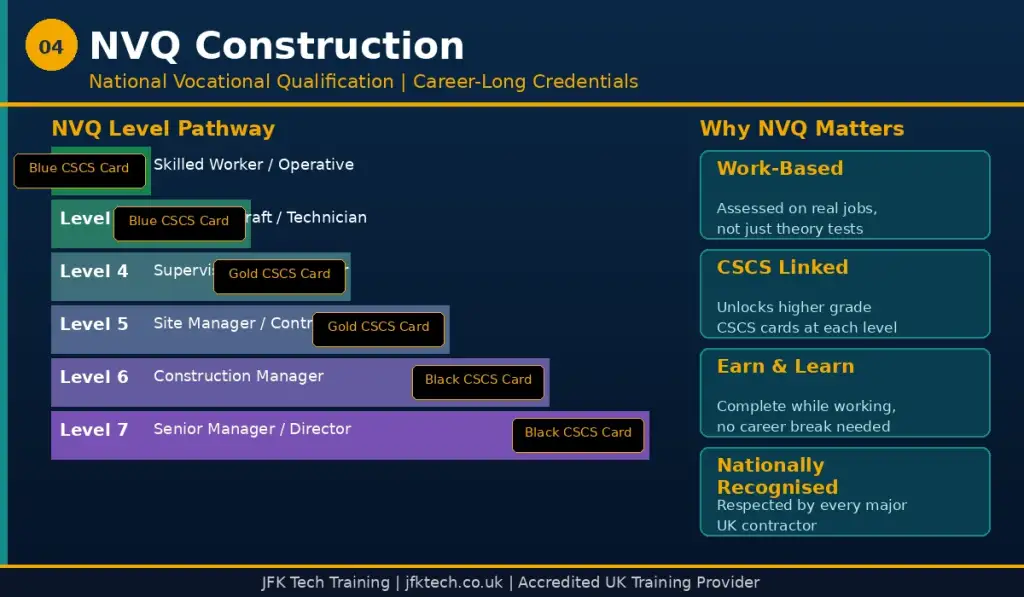
NVQ stands for National Vocational Qualification, and in the construction industry, it is the most important competency-based qualification you can earn. Unlike a short course, an NVQ assessment takes place over time and is based on real work you carry out in your actual job. This makes it highly credible to employers because it proves you can actually perform the work — not just pass a theory test.
Construction NVQs run from Level 2 through to Level 7. Level 2 suits operatives and skilled tradespeople. Levels 3 and 4 are aimed at supervisors and technicians. Levels 5, 6, and 7 are for project managers, site managers, and senior construction professionals working at the very top of the industry.
Why do UK employers rate NVQs so highly?
NVQs are directly linked to your CSCS card grade. A Level 2 NVQ gets you a blue skilled worker card. A Level 6 or 7 NVQ in construction management gets you the black CSCS card, the highest grade available. Employers know that a candidate with an NVQ has been assessed against national occupational standards over a sustained period of real work, which carries far more weight than a short course alone. Explore all available levels through our dedicated NVQ construction courses page.
How long does an NVQ take to complete?
Timeframes vary depending on the level and your current role. Level 2 NVQs typically take six to twelve months. Higher levels can take up to eighteen months. The great advantage is that you can work and study at the same time, no career interruption required. Browse our full range of NVQ courses for construction workers to find the right level for where you are in your career right now.
CPCS Card — The Must-Have for Plant Operators
If you operate any plant machinery on a UK construction site, from excavators and dumpers to cranes and telehandlers, you need a CPCS card. The Construction Plant Competence Scheme card is the industry-recognized proof that you are trained, assessed, and competent to operate specific categories of plant machinery safely and legally on UK sites.
The scheme works in two stages. First, you earn the red trained operator card after passing a CITB Plant Operator Health and Safety test and a practical assessment for your chosen plant category. Then, after demonstrating two years of on-site experience, you upgrade to the blue competent operator card, which most major employers and contracts specifically require.
CPCS vs NPORS—which card do UK employers prefer?
Both CPCS and NPORS cards are accepted on UK sites, but CPCS is the more widely recognized of the two, particularly on large commercial and infrastructure projects. If you are aiming to work for major principal contractors or on nationally significant schemes, getting a CPCS card gives you the strongest possible position when applying for plant operator roles.
Which plant categories can you train for?
There are over 60 CPCS plant categories available, ranging from compact equipment all the way up to heavy lifting machinery. At JFK Tech Training, we run CPCS training across a wide range of categories. You can view everything available and book your assessment through our CPCS plant operator courses page. Our team will also help you prepare for the CITB theory test, which most candidates find the most challenging part of the process.
Bonus: First Aid Training — The Certification That Keeps Everyone Safe
No list of must-have construction certifications is truly complete without mentioning First Aid. Under current HSE guidelines, every UK construction site must have an adequate number of trained first aiders present during working hours. Employers take this requirement seriously. and workers who hold a valid first aid certification for construction sites are always in high demand because they add an immediate, practical layer of value to any site team.
Whether you choose Emergency First Aid at Work (EFAW) for a one-day qualification or the full First Aid at Work (FAW) course over three days, both are widely recognized across the UK construction industry. Combine either of these with any of the five main certifications listed above and you immediately stand out from the competition when applying for roles.
Frequently Asked Questions
Absolutely. Many of our construction courses in London are open to complete beginners with no prior experience. We design courses like the CSCS card preparation, SSSTS, and NVQ Level 2 as accessible entry-level starting points. Our team will assess your background and recommend the most suitable starting point for your goals and timeline.
Some certifications, like the CSCS card, can be achieved in under a week once you have passed the CITB test. SSSTS takes two days. SMSTS takes five days. If speed is your priority, contact our enrollment team, and we will outline the quickest compliant path to your desired role without compromising on quality.
Yes. This guide covers five nationally recognized certifications—CSCS, SMSTS, SSSTS, NVQ, and CPCS—across England, Scotland, Wales, and Northern Ireland. They are portable across employers too, which means your qualifications move with you wherever your career takes you throughout your working life.
Not necessarily. The certifications you need depend entirely on your specific role on site. A laborer needs a CSCS card. A plant operator needs a CPCS card. A supervisor needs SSSTS. A site manager needs SMSTS. An NVQ adds long-term career value for almost anyone. Our team can help you identify exactly which combination applies to your situation right now.


2 Comments
Thierno
Really impressed with the information, but can you let me know more about this.
Kay
Yes Thierno, you can visit our this page https://jfktech.co.uk/construction-courses for more information.