
If you work in construction or you are planning to start, you have almost certainly come across the term NVQ. Employers mention it during interviews, contractors require it for site access, and the CSCS card system ties directly to it at every level. Yet despite how frequently the qualification comes up, a surprising number of construction workers remain unclear about what the different NVQ levels actually mean, which one applies to their role, and what happens after they complete one.
This guide breaks all of that down clearly and honestly. It covers every level of NVQ construction courses from Level 2 through to Level 7, explains what each one qualifies you for, and helps you identify exactly which level makes sense for where you are in your career right now.
What Is an NVQ and Why Does Construction Rely on It So Heavily?
A National Vocational Qualification—NVQ—is a work-based qualification that proves you can perform your job to a nationally recognized standard. Unlike academic exams that test what you know in a classroom, an NVQ assesses what you actually do on-site. A qualified assessor visits your workplace, observes you working, reviews evidence such as risk assessments and method statements, and asks structured questions about your practice. If your performance meets the required standard across all assessed units, you receive your qualification.
Construction relies on NVQs more heavily than almost any other industry for two specific reasons. First, the CSCS card scheme—which controls access to the vast majority of UK building sites—links directly to NVQ levels. Without the right NVQ, you cannot obtain the CSCS card that matches your role, which means you cannot legally access many sites. Second, the nature of construction work demands demonstrable competence rather than theoretical knowledge. An assessor watching you plan a safe lifting operation or manage a site induction provides far stronger evidence of ability than a written test ever could.
The NVQ Level Structure at a Glance
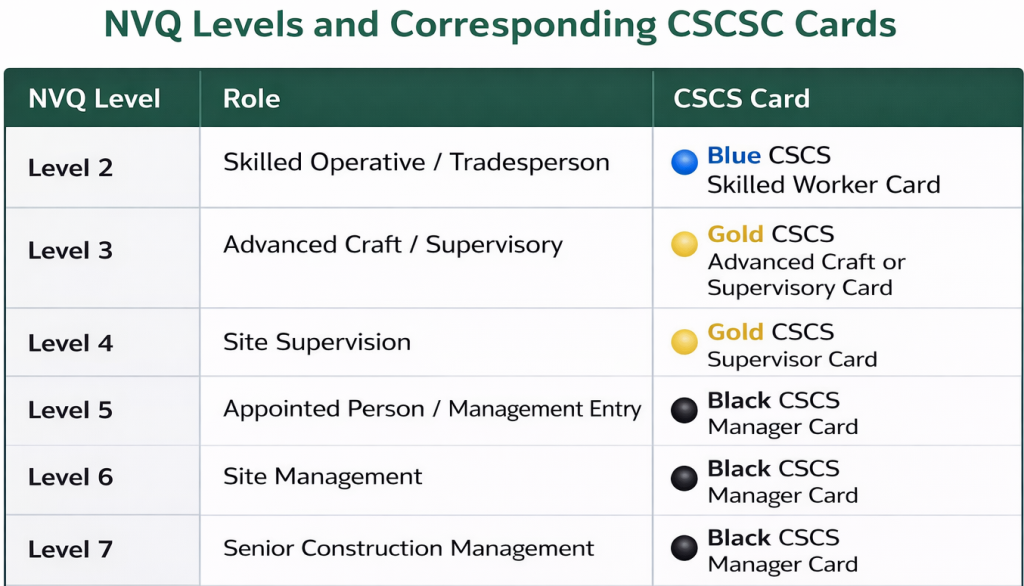
NVQ construction courses run from Level 2 at the skilled worker entry point up to Level 7 for senior management. Each level corresponds to a specific tier of responsibility on-site, and each level unlocks a different CSCS card color. Understanding this relationship before you choose a course saves you from enrolling at the wrong level and either underqualifying or overcomplicating your pathway unnecessarily.
Here is how the levels map against roles and CSCS cards:
NVQ Level 2—The Starting Point for Qualified Tradespeople
NVQ Level 2 suits operatives and tradespeople who want to formalize the skills they already use on-site every day. It covers essential workplace competencies, health and safety standards, and the technical knowledge relevant to your specific trade—whether that is groundworks, bricklaying, carpentry, plant operation, or any other construction discipline.
To enroll, you need to be actively working in a relevant construction role so your assessor can observe you in a real working environment. You also need to pass the CITB Health, Safety, and Environment (HS&E) test, which forms part of the qualifying requirements for the Blue CSCS Skilled Worker Card that the Level 2 NVQ unlocks.
The assessment period typically runs for a minimum of three months, though it often extends to six months or longer depending on how quickly you can gather the required portfolio evidence. The qualification demonstrates to employers that your skills meet a nationally recognized standard—not just that you have been on-site for a few years, but that you perform to a verified level of competence.
For anyone currently holding a temporary CSCS card or working without formal certification, completing an NVQ Level 2 through accredited construction courses is the single most direct route to a permanent, recognized qualification.
NVQ Level 3—Advanced Craft and Supervisory Roles
Level 3 targets experienced operatives who either work at an advanced craft level within their trade or take on supervisory responsibilities for a team of workers performing the same type of work. It also suits foremen who oversee small groups of operatives and need to formalize their supervisory competence.
This level covers advanced technical skills, higher-level safety responsibilities, and the leadership capabilities that supervisory work demands. The assessment process takes between three and twelve months depending on the nature of your role and the frequency of assessor visits.
Completing Level 3 enables you to apply for the Gold CSCS Advanced Craft Card or the Gold CSCS Supervisory Card, depending on the specific qualification pathway you follow. These cards represent a significant step up from the blue card and open access to roles with greater responsibility, higher day rates, and wider project opportunities.
Many candidates who complete NVQ construction courses at Level 3 find that the qualification also accelerates conversations with employers about promotion—because the assessor’s evidence portfolio provides documented proof of supervisory competence that a CV alone cannot convey.
NVQ Level 4—Formalizing Site Supervision Competence
Level 4 applies specifically to site supervisors who oversee small- to medium-sized construction projects from start to finish. It focuses on project supervision across the full lifecycle—from planning and programming through execution, compliance, and handover. The qualification also emphasizes team management, regulatory compliance, and the communication skills that effective supervision requires.
If your day-to-day role involves managing trades, monitoring quality and safety compliance, coordinating subcontractors, or reporting progress to a site manager, then NVQ Level 4 aligns with where you already operate. The assessment process takes the same three to twelve months. range as Level 3, and the resulting qualification supports applications for the Gold CSCS Supervisor Card.
For those considering NVQ construction courses for the first time and currently working as a supervisor without formal credentials, Level 4 provides the most direct route to a qualification that accurately reflects your actual responsibilities on-site.
NVQ Level 5—Appointed Person and Management Entry
Level 5 occupies the space between operational supervision and full site management. The most common application at this level involves the Appointed Person role—the individual responsible for planning, supervising, and controlling lifting operations on construction sites.
The Level 5 qualification in this context covers lifting plan creation, risk assessment specific to lifting operations, equipment selection, legal compliance, and team briefing. It suits construction professionals who already hold strong operational experience and carry planning responsibilities that go beyond direct supervision.
Completing NVQ Level 5 contributes toward eligibility for the Black CSCS Manager Card, which requires an NVQ or SVQ at Level 5, 6, or 7 in a relevant construction management discipline, combined with passing the CITB Managers and Professionals Health, Safety, and Environment test.
NVQ Level 6—Site Management
Level 6 is the qualification most commonly associated with experienced site managers running large-scale construction projects. It covers the full scope of site management competence—contract management, quality control, resource planning, health and safety compliance, team leadership, and client and stakeholder communication.
The construction industry increasingly treats Level 6 as the baseline expectation for anyone in a site management role. Since January 2025, the industry-wide phase-out of Industry Accreditation CSCS cards means that around 60,000 site managers and assistant site managers who previously relied on IA-route cards now need a nationally recognized qualification to renew. For the majority of those workers, the NVQ Level 6 is the qualification that resolves that requirement.
Completing Level 6 through recognized NVQ construction courses unlocks the Black CSCS Manager Card and, for those interested in professional body membership, satisfies part of the requirements for Associate or Member status with the Chartered Institute of Building (CIOB).
NVQ Level 7—Senior Construction Management
Level 7 sits at the top of the NVQ framework and targets company directors, senior project managers, contract managers, senior quantity surveyors, and senior estimators. It focuses on strategic management, business operations, corporate governance, and high-level decision-making that affects entire organizations rather than individual projects.
This is not a qualification for someone stepping into management for the first time. NVQ Level 7 suits professionals who already operate at a strategic level and want a national qualification that formally reflects the scope of their responsibilities. It also supports applications for the Black CSCS Manager Card and can contribute toward Chartered Member status with professional bodies including the CIOB and the Chartered Association of Building Engineers (CABE).
How NVQ Assessment Actually Works in Practice
Regardless of the level you pursue, the assessment process follows the same fundamental structure. An approved assessor—someone with direct industry experience in your area of work—visits your workplace on multiple occasions throughout the assessment period. During these visits, they observe you performing your role, review documentary evidence you have compiled, and conduct structured professional discussions to test your underpinning knowledge.
The evidence portfolio you build throughout the process includes documents like risk assessments, method statements, toolbox talk records, site induction sign-off sheets, quality control checklists, and witness testimonies from line managers or colleagues. This portfolio is what the awarding body reviews when making its final competence decision.
Because the assessment takes place in your actual working environment rather than a test center, you do not need to take time away from the site to complete NVQ construction courses. Most candidates complete their assessment alongside their normal working commitments, which makes the qualification accessible even for full-time workers with demanding schedules.
Which NVQ Level Do You Actually Need?
The honest answer depends on three things: your current role, the CSCS card you need to carry, and where you want your career to go in the next two to five years.
If you work as a tradesperson or operative and need a permanent CSCS card, start at Level 2. If you supervise a small team or work at an advanced craft level in your trade, Level 3 or Level 4 is your entry point. If you manage a site—even a smaller one—Level 6 is increasingly the industry standard. If you operate at a strategic or senior management level, Level 7 reflects your actual responsibilities and opens the most senior CSCS and professional body routes.
One practical consideration worth noting: enrolling at too low a level wastes time and money because you will need to return for the higher qualification anyway. Speak to an approved assessor or training provider before you book, describe your actual role and daily responsibilities honestly, and let that conversation guide the level you choose. A good provider will match you to the right course rather than defaulting to whatever is cheapest or most convenient for them.
Investing in the right level of NVQ construction courses from the outset means you complete the process once, emerge with a qualification that genuinely reflects your competence, and carry a CSCS card that opens the doors your career actually needs.
Frequently Asked Questions
NVQ Level 2 suits skilled operatives and tradespeople who perform practical site work. Level 3 applies to those working at an advanced craft level or taking on supervisory responsibilities. Level 2 leads to the Blue CSCS Skilled Worker Card, while Level 3 unlocks the Gold CSCS Advanced Craft or Supervisory Card. Your current job role, not your years of experience alone, determines which level you should pursue.
Yes—this is one of the most significant advantages of the NVQ format. Assessment takes place in your actual workplace during your normal working day. You do not need to attend a college or take time away from the site. An approved assessor visits you at work, observes your practice, and reviews evidence you compile alongside your daily duties. Most candidates complete their NVQ without disrupting their income or their employer’s schedule in any meaningful way.
Duration varies by level and individual circumstance. NVQ Level 2 takes a minimum of three months, though many candidates take between three and six months to gather sufficient evidence. Levels 3 through 7 typically run between three and twelve months. The pace depends largely on how frequently your assessor can visit, how quickly you compile your evidence portfolio, and the variety of work your role exposes you to during the assessment period.
The Black CSCS Manager Card requires an NVQ or SVQ at Level 5, 6, or 7 in a relevant construction management discipline. You must also pass the CITB Managers and Professionals Health, Safety, and Environment test within the two years preceding your card application. For most site managers, the NVQ Level 6 in Construction Site Management is the most directly relevant qualification for this card.
The NVQ assessment itself does not require you to pass an entry test. However, many NVQ levels—particularly Level 2 — require you to pass the CITB Health, Safety and Environment test as part of the overall process for obtaining your CSCS card on completion. Your training provider or assessor will advise you which tests apply to your specific level and trade at the outset of your assessment.