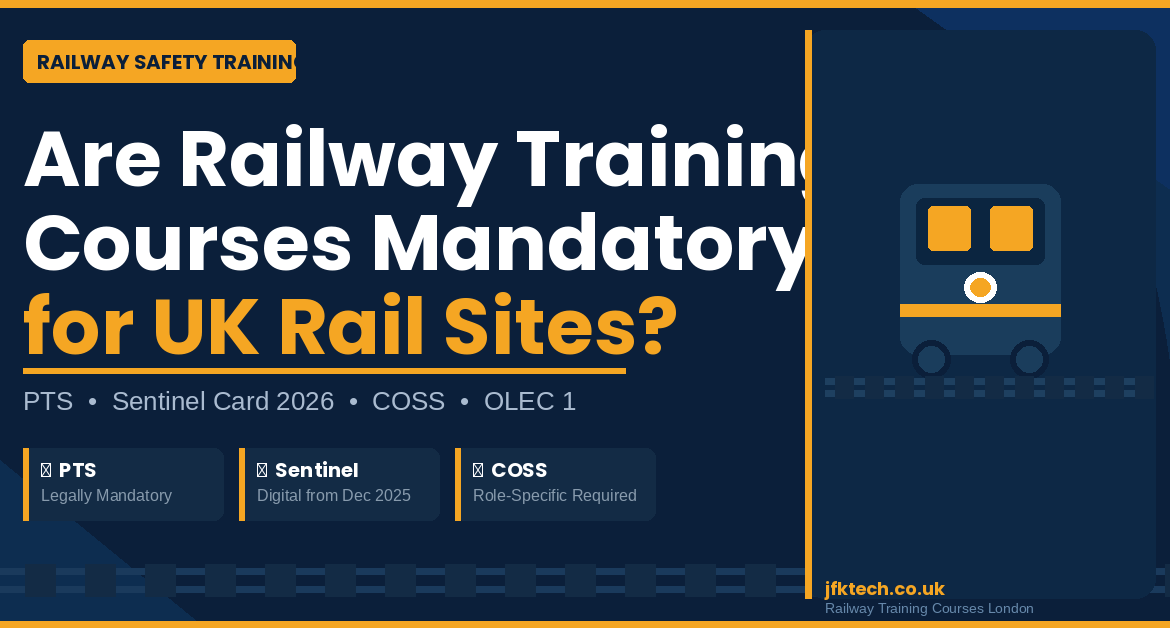
Legal Requirement for PTS
This is not a recommendation. It is the law.
Under Network Rail Safety Standards and the Health and Safety at Work Act 1974, every person working on or near the line must hold a valid Personal Track Safety (PTS) certificate. There are no exceptions for contractors, subcontractors, or self-employed workers. If you step onto Network Rail-managed infrastructure without a current PTS qualification, you are in breach of safety law—and so is the employer who allowed you to do so.
The reason is straightforward. Railway tracks carry live trains at high speed, often in both directions, with minimal advance warning. The risk of a fatality without proper awareness training is not theoretical. It is why the industry enforces these standards without flexibility.
PTS training gives workers a solid understanding of safe working practices, how to interpret line-of-route instructions, the roles of safety personnel on site, and how to respond correctly in an emergency. This knowledge is not optional background reading — it is the foundation for staying alive on the track.
Railway training courses in London that include PTS remain the most common starting point for anyone entering the UK rail industry.
The Sentinel Card: Your Digital Passport to the Track
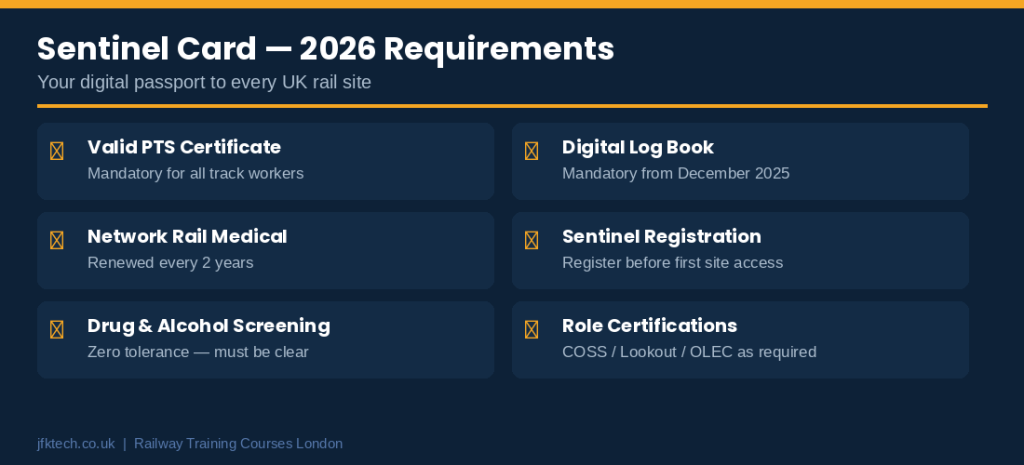
The Sentinel card is the official competence management system used across the UK rail industry. Every railway worker must hold a valid, active Sentinel card that records their qualifications, medical clearances, and training history.
Before December 2025, workers could maintain paper-based logbooks to record their competence and practice hours. That has now changed.
From December 2025, the use of digital sentinel logbooks is mandatory. All practice records, competence updates, and training completions must be logged digitally through the Sentinel system. Paper records are no longer accepted as proof of compliance.
What this means for anyone new to the industry in 2026:
- You must register on the Sentinel system before seeking site access.
- Your qualifications — including PTS, medicals, and drug and alcohol screening — are verified through the digital record.
- Employers and site controllers check your Sentinel card electronically before granting track access.
- Any lapse in medical clearance, expired certification, or failed screening is immediately visible in the system.
If your Sentinel card does not show a valid PTS qualification and a current medical, you will not pass the site gate. Completing your railway training courses in London through an accredited provider ensures that your certifications upload directly to your Sentinel record without delay.
What Is Included in the PTS Full Package?
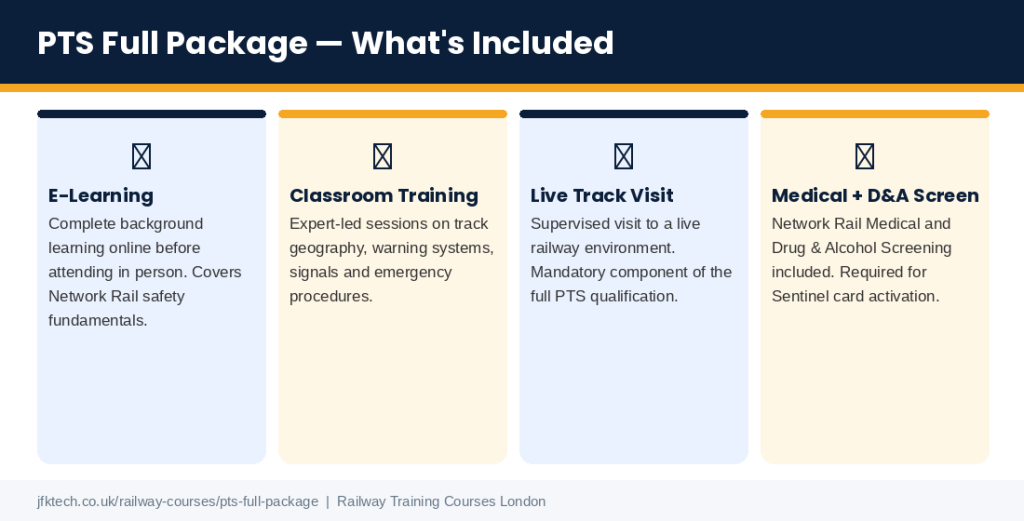
JFK Tech Training offers the PTS Full Package as a complete solution for workers who need to gain track access from scratch. It is the most thorough way to meet all baseline Sentinel card requirements in a single structured program.
The PTS Full Package covers the following:
E-Learning Pre-Course Work Before attending classroom and practical sessions, delegates complete essential background learning online. This covers the fundamentals of railway safety, Network Rail standards, and the responsibilities of a track worker. Completing this pre-course work means classroom time focuses on applied knowledge and assessment rather than introducing basic concepts from scratch.
Classroom and Theory Training Structured sessions delivered by experienced railway safety professionals. Topics include track geography, lookout and warning systems, signals and sightings, emergency procedures, and the roles and responsibilities of all personnel on a live rail site.
Live Track Visit This is where classroom knowledge meets real-world application. Delegates attend a controlled live track visit, gaining direct experience of the railway environment under expert supervision. This practical element is a mandatory component of the full PTS qualification.
Medical and Drugs & Alcohol Screening
You cannot receive a PTS certificate or a valid Sentinel card without passing both a Network Rail medical and a drug and alcohol screening.
The medical assessment covers eyesight, hearing, color vision, BMI, coordination checks, and a review of your medical history and current medications. This ensures every worker on the track meets the physical and health standards required for safety-critical roles.
The drug and alcohol screening is a zero-tolerance requirement. Network Rail operates mandatory testing, and a positive result immediately disqualifies a worker from site access. Both the medical and screening are included within the PTS Full Package at JFK Tech, removing the need to source these assessments separately.
Upon successful completion of all components, delegates receive their PTS qualification, which loads directly onto their Sentinel card and activates their track access credentials.
Mandatory vs. Optional Courses
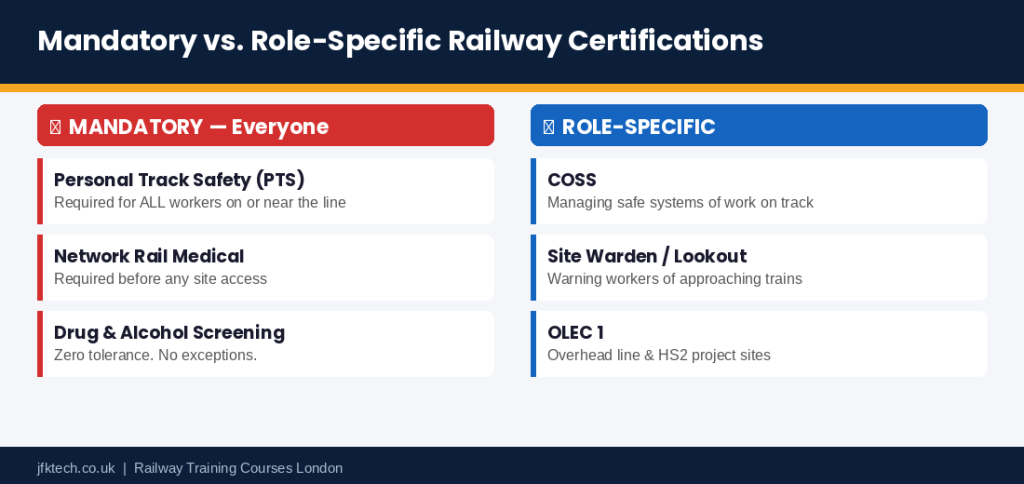
Not every railway training course carries the same legal weight. Here is how to understand which qualifications are mandatory for your role and which are role-specific additions.
Mandatory for all workers on or near the line: Personal Track Safety (PTS) and a valid Network Rail Medical are non-negotiable requirements for every individual accessing tracked infrastructure. Without both, site access is refused regardless of experience or employer.
Role-specific mandatory certifications:
Controller of Site Safety (COSS)
If your role involves managing safe systems of work on the track—controlling possession boundaries, issuing line blockages, or authorizing other workers to enter a protected area—you must hold a COSS qualification. A COSS carries legal responsibility for the safety of their team on a live rail site. This is not an optional upgrade; it is a legal requirement for the role. The COSS initial course runs for 8 days and includes PTS recertification as part of the program.
Site Warden and Lookout
A site warden or lookout provides a warning to workers when a train approaches. This is a safety-critical role and requires specific certification that covers emergency procedures, warning methods, and direct communication with COSS personnel. Workers performing this duty without the correct qualification put themselves and their entire team at risk.
OLEC 1 — Overhead Line Electrification Construction
Anyone working on or adjacent to overhead line construction projects — including HS2 and Network Rail electrification schemes — must complete OLEC 1 training after their PTS. The course covers the specific hazards of working near energized overhead equipment and is mandatory for these project types.
Why Choose a Railway Training Course in London?
London and the surrounding area represent one of the most active rail infrastructure markets in the UK. Projects such as the Elizabeth line, ongoing Network Rail upgrades across the capital, HS2 enabling works in and around the city, and Thameslink infrastructure improvements mean consistent demand for qualified rail workers across East and West London, Essex, and the Home Counties.
JFK Tech Training is based at the CEME Innovation Centre, Rainham, RM13 8EU—directly accessible from West Ham, Barking, Dagenham, and Stratford and across East London via the District and Overground lines. For workers living and working in London, this location removes the need to travel to training centers in the Midlands or North of England.
Taking your railway training courses in London through a provider based in the city gives you additional practical advantages:
- Course availability aligns with live project start dates on London infrastructure.
- Local knowledge from trainers who have worked on London rail projects.
- Fast medical and screening turnaround, so your Sentinel card activates without unnecessary delays.
- The ability to begin work on local rail sites immediately after qualification.
For employers, having a nearby training provider means workers can complete qualifications, return to work, and contribute to live projects on tight program schedules.
Conclusion
Railway training courses are not optional extras or box-ticking exercises. In the UK rail industry, they are the legal baseline for safe working. Personal Track Safety is mandatory for everyone who sets foot near the line. Your Sentinel card — now managed exclusively through the digital system as of December 2025 — is the only evidence of compliance that site controllers and employers accept.
Whether you are entering the rail industry for the first time or renewing lapsed qualifications, completing the right training through an accredited provider is the only way to gain lawful track access.
Frequently Asked Questions
Yes. Any access to Network Rail-managed infrastructure—including controlled areas near the track—requires a valid PTS and a current Sentinel card. There is no short-term visitor exemption for unqualified individuals.
A full PTS qualification is valid for three years, provided your Network Rail medical remains current. A medical renewal is required every two years, so most workers will need a medical update before their PTS expires.
If your qualification, medical, or drug and alcohol screening expires, your Sentinel card becomes inactive. You cannot legally access any rail site until you reinstate the relevant certification. With digital sentinel logbooks now mandatory from December 2025, lapses are immediately visible to site controllers.
Yes. The PTS Full Package is designed for workers entering the rail industry for the first time. The e-learning component and classroom sessions build the knowledge base from the ground up before the live track assessment.
Once your PTS training, medical, and drug and alcohol screening results are submitted to the Sentinel system, your card typically activates within a few working days, subject to system processing times.