

Most people don’t consider renewing their CPCS card until it’s nearly too late. You’re busy on site, life gets in the way, and suddenly you’re looking at a card that expires in six weeks. Sound familiar? You’re not alone; this guide will help you in plain English, with no jargon.
Whether you’re renewing for the first time or you’ve done it before and just need a refresher on what’s changed, this resource is the only guide you need. We’ll cover what the CPCS renewal test actually involves, what documents you need, how long the process takes, and how to find the right CPCS training courses to support you along the way.
First Things First: Exactly What Is the CPCS Blue Card?
Before we delve into the renewal process, it’s important to ensure that we all have a clear understanding of the topic. The Construction Plant Competence Scheme (CPCS) is the industry-recognized certification that proves you’re qualified and competent to operate plant machinery on UK construction sites. Think excavators, telehandlers, dumpers, and cranes—if it has heavy machinery involved, you need a CPCS card to operate it legally and safely.
There are two main cards most operators deal with:
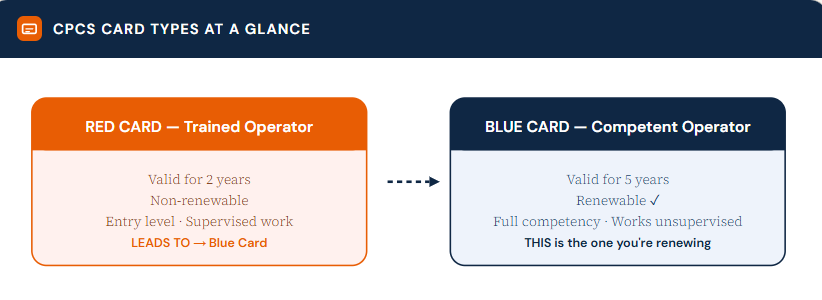
The Red Card (Trained Operator Card) is where everyone starts. It lasts two years and cannot be renewed; the expectation is that during those two years you gain your NVQ and move up to the Blue Card. The Blue Competent Operator Card is what most experienced operators hold. It lasts five years, and yes, it absolutely can and should be renewed before it expires.
How Long Do You Actually Have to Renew?
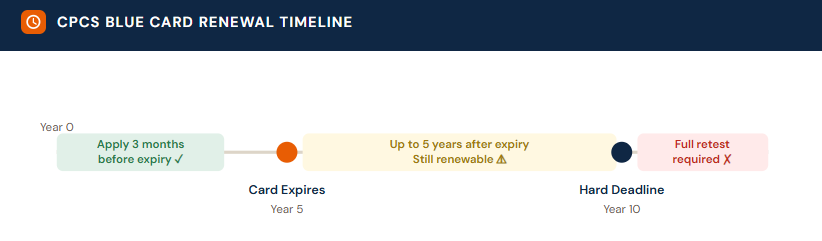
Here’s the part people get confused about. Your Blue Card expires after five years, but that doesn’t mean you have to start panicking the moment it runs out. CPCS gives you a grace window, but it’s important to understand exactly what that looks like.
You can apply to renew your card up to three months before it expires, so don’t wait until the last day. After the expiry date, you technically have up to five years to renew, but working with an expired card on a regulated site isn’t something any reputable employer will allow. If more than five years pass, you’re back to square one, with full theory and practical tests—the whole lot.
What Are the Requirements for the CPCS Renewal Test?
The renewal process is where many people get caught out. CPCS renewal isn’t just filling in a form—there are specific things you need to have in place before you can apply. Think of it as three separate boxes you need to tick, and all three must be ticked before your new card gets issued.
1. The CITB Health, Safety and Environment Test
This is the same health and safety exam you took when you first got your card. You need to have passed it within the last two years before your renewal application. The operatives’ level test works for most categories. However, if you hold the A61 (Appointed Person) category, you’ll need the Managers and Professionals (MAP) level test instead.
2. The CPCS CPD Renewal Test
The CPCS CPD Renewal Test is the big change that came in from August 2024. The old paper-based renewal tests (you might remember them as RT17, RT59, and so on) have been replaced by a modern online CPD eLearning system run through the NOCN Hub. There are five modules in total, and you only complete the ones relevant to the categories on your card. Each module takes around 30 to 40 minutes; you can do it on your phone or laptop, and there’s no pass or fail—it’s about demonstrating ongoing professional development. Much more straightforward than the old system.
3. Proof of Practical Experience
You need to show that you’ve actually been using your skills. The most common route is the logbook route—you keep a record of your operating hours using the official CPCS logbook, which your employer signs off. Alternatively, you can use an employer’s letter confirming your ongoing use of the plant or go through an NVQ assessment if you’d prefer a more formal qualification route.
Step-by-Step: How to Renew Your CPCS Blue Card
Right, let’s get practical. Here’s the exact process, in order, so you know precisely what you’re doing and when. Follow these steps and your renewal should be smooth from start to finish.
Check Your Card’s Expiry Date and Get Organised
Look at your Blue Card right now. Note the expiry date and count back three months—that’s your target start date. Don’t wait any longer than that. While you’re at it, check whether your CITB Health and Safety test is still valid. If it was more than two years ago, it’s expired, and you’ll need to sit it again.
Book and Pass Your CITB Health, Safety and Environment Test
Head to the CITB website and book your HS&E test at an approved test center. This is a touch-screen multiple-choice exam covering health and safety on construction sites. Most operators pass without much difficulty—especially if you’ve been working on regulated sites for years. There are official revision materials available online if you want to brush up beforehand. The test certificate is valid for two years from the date you pass.
Gather Your Proof of Practical Experience
The most popular route here is the CPCS logbook. You’ll need your completed logbook showing regular use of your plant category, signed off by your employer or site manager. If you don’t have a logbook, you can still get a signed letter from your employer confirming your ongoing practice. A third option is to go through an NVQ assessment, though this is generally a longer process and usually only chosen when the logbook evidence isn’t available.
Complete the F1/3 Application Form
The F1/3 is the official CPCS renewal application form. You can submit this online through the NOCN portal or by post if you prefer. You’ll need your personal details, card number, test certificates, and experience evidence. Double-check every field before you submit; errors are the most common cause of delays. Pay the £28 renewal fee when prompted (the amount is the same whether you’re renewing one category or several).
Wait for Your New Blue Card to Arrive
Once your application is processed, your new CPCS Blue Card should arrive within about 14 days. It’ll be valid for five years from your previous card’s expiry date, so even if you renewed a month early, you’re not losing any time. If it hasn’t arrived within 14 days, contact the CPCS helpline center.
What CPCS Training Courses Can Help You Prepare?
Some operators feel completely confident going into renewal on their own, and that’s fine. But many find it useful to take a structured CPCS course or attend a refresher session before sitting the CITB health and safety test, particularly if it’s been a while since they last sat any kind of formal assessment.
Here’s what the right CPCS training courses can do for you:
At JFK Tech Training, our CPCS training courses are designed around exactly what you need as a plant operator, not a generic classroom experience. Our trainers have real site experience. They know the tests, they know what assessors look for, and they know how to get you ready efficiently without wasting your time.
One thing people often don’t realize is that renewal time is actually a great opportunity to add a new category to your card. If you’ve been operating a machine for a while that’s not yet on With your card, you can go through the testing process at the same time as the renewal. It’s a cost-effective way to expand your skill set and increase your earning potential.
What Happens If You Let Your CPCS Card Expire?
Life happens. Sometimes operators miss the window. If your card has already expired, here’s a clear picture of where you stand depending on how long it’s been:
The key message here is simple: don’t work with an expired card. Even if you’re confident in your abilities, it’s not worth the risk—to you, to your employer, or to others on site. If your card has expired for less than five years, start the renewal process today. If it’s been longer than that, you’ll need to go back through the full process, which is precisely what our CPCS course at JFK Tech Training is designed to support.
Frequently Asked Questions
The card itself costs £28 to renew. On top of that, you’ll pay for the CITB HS&E test (around £22.50) and the NOCN CPD eLearning fee. If you’re attending a CPCS training course for support, that’s an additional cost depending on the provider and what’s included.
Yes, but proving practical experience without active employment is the tricky part. You can use logbook entries from previous work, as long as they demonstrate recent use of your category. Speaking to a training provider like JFK Tech can help you understand the best route given your situation.
Realistically, allow four to six weeks from start to finish. The HS&E test needs to be booked in advance, the CPD modules take a few hours across multiple sessions, and once you submit your F1/3 application, allow up to 14 days for the card to arrive. Start three months before your expiry date to allow yourself plenty of buffer time.
You’ll need to complete the CPD renewal modules for each category—though the five modules cover all current CPCS categories, so there’s significant overlap. You’ll also need to demonstrate experience in each category, and you pay a single £28 fee regardless of how many categories you’re renewing.
The new online CPD format is far more straightforward than the old renewal tests. There’s no pass or fail—it’s a professional development exercise. The CITB HS&E test If you’ve been working safely on UK construction sites, most of the knowledge will be second nature, but it still requires preparation.


2 Comments
Abbas
Thank you for this info
John
This is a helpfull blog