If you’ve been working in construction for a while, or you’re trying to figure out how to get started, you’ve almost certainly come across three qualification names that seem to overlap with each other: NVQ, BTEC, and City & Guilds. They all sound official. They all carry weight. And nobody seems to explain clearly what makes them different or which one is actually going to move your career forward.
This guide cuts through the confusion. We’re going to explain what each qualification is, how they compare against the things that actually matter, employer recognition, CSCS card eligibility, cost, and study method, and then give you a straight answer about which one makes sense depending on where you are in your career right now.
We’ll also show you exactly how nvq construction courses at JFK Tech Training can unlock your next CSCS card grade and open up higher-paying site roles, whether you’re a laborer aiming for your first skilled worker card or an experienced site supervisor targeting the Black CSCS card at Level 6 or 7.
What Are NVQs, BTECs, and City & Guilds Qualifications?
NVQ — National Vocational Qualification
An NVQ is a work-based qualification. That’s the most important thing to understand about it. You don’t attend college or sit traditional exams. Instead, you build a portfolio of evidence drawn directly from your real job on-site, observations, witness testimonies, work products, and professional discussions with your assessor. This makes NVQs incredibly practical and highly credible to employers, because they prove you can actually do the work, not just describe it.
NVQs run from Level 2 to Level 7 in construction. They’re directly linked to your CSCS card grade, which means an NVQ is often the most efficient route to unlocking a higher card, a better job title, and a higher wage. At JFK Tech Training, our NVQ construction courses cover every level from 2 right up to 7.
BTEC — Business & Technology Education Council
A BTEC is a classroom and college-based qualification. It’s delivered by teachers or lecturers, involves a mix of coursework assignments and exams, and gives you a strong theoretical foundation in construction principles. BTECs are particularly common among school leavers and young people entering the industry through a college pathway because they don’t require prior work experience.
The trade-off is that BTECs take longer and don’t always translate directly into the CSCS card grade or job-ready competence that employers on commercial sites are looking for. They’re valuable, but they’re the beginning of a journey rather than a standalone career accelerator.
City & Guilds
City & Guilds is an awarding body rather than a single type of qualification. It awards both NVQs and its own standalone accredited certificates across construction trades. City & Guilds delivers many of the short trade courses, apprenticeship components, and CPD awards in construction. It’s widely respected in the industry and covers Levels 1 through 8.
The key thing to understand is that City & Guilds and NVQs are not mutually exclusive; often, a City & Guilds NVQ is the same thing. What sets City & Guilds apart as a standalone route is its range of shorter, trade-specific awards that work well for continuing professional development rather than primary career qualifications.
NVQ Construction Levels and Your CSCS Card
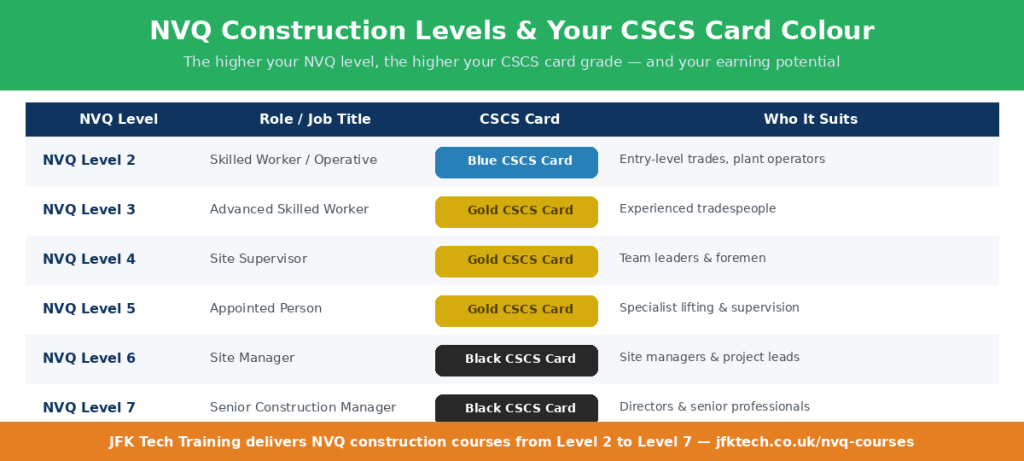
One of the biggest reasons UK construction workers choose an NVQ course over other qualification routes is the direct link between NVQ level and CSCS card color. Your CSCS card is what gets you through the site gate, and its color tells employers instantly what level of competence and responsibility you hold.
Here is how the levels break down and what they mean in practice for your career on UK construction sites.
- NVQ Level 2 earns you the Blue Skilled Worker CSCS card. This is the standard entry point for tradespeople and plant operators—bricklayers, carpenters, electricians, and CPCS-qualified plant operators all typically work toward this level.
- NVQ Level 3 and Level 4 support the Gold CSCS card and represent experienced, advanced trades or supervisory roles. If you lead a small team on site, this qualification is the level you should be targeting.
- NVQ Level 5 is associated with appointed personnel roles and specialist functions, particularly useful in lifting operations and project coordination.
- NVQ Level 6 unlocks the Black CSCS card for site managers. This is one of the most significant career milestones in UK construction, opening the door to site management roles with principal contractors.
- NVQ Level 7 is for senior construction managers and project directors, the top grade on the CSCS card and the highest NVQ level in the construction framework.
You can view the full range of NVQ construction courses from Level 2 to Level 7 at JFK Tech Training, including specific information on duration, price, and what each level involves.
NVQ vs BTEC vs City & Guilds: A Direct Comparison
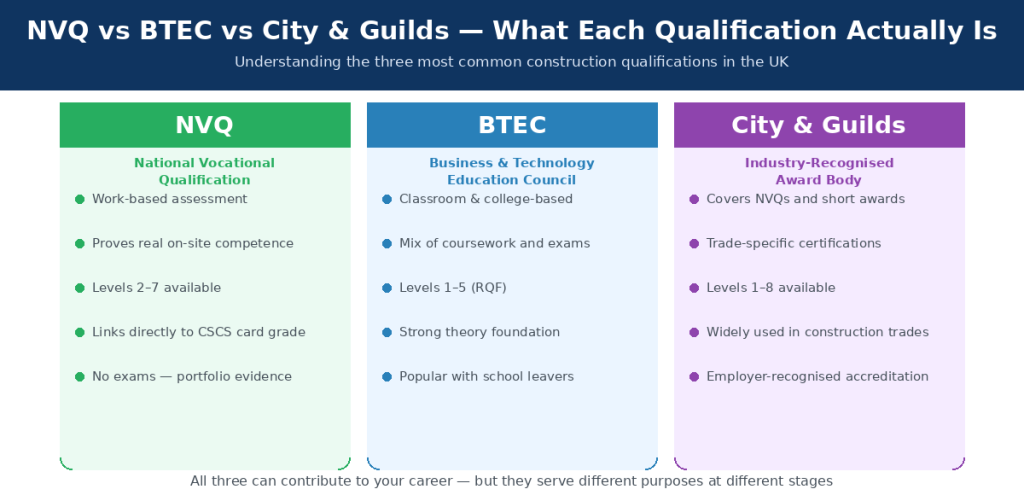
Now let’s look at the actual differences that matter when you’re deciding where to invest your time and money.
Employer Recognition
In the UK construction industry, NVQs consistently achieve the strongest employer recognition among workers already in the field. This is because NVQs are competency-based; they prove you can do the job. Principal contractors, project managers, and site supervisors know that an NVQ Level 6 candidate didn’t just pass an exam; they demonstrated consistent competence over months of real work. BTEC and City & Guilds awards are respected, but they carry more weight in education and training environments than on a commercial construction site.
CSCS Card Eligibility
NVQs have the clearest and most direct pathway to CSCS card upgrades. BTEC qualifications can contribute toward CSCS eligibility in some circumstances, but the route is less direct and often requires additional assessment. City & Guilds NVQs work the same way as any other NVQ for CSCS purposes, but standalone City & Guilds certificates do not automatically unlock specific card grades.
Study Method
This aspect is where personal circumstances matter most. If you’re already working on-site, the NVQ work-based model is a genuine advantage; you study around your job and submit evidence from what you’re doing every day. BTEC requires regular college attendance, which can be difficult to fit around a working schedule. City & Guilds awards vary; some are short courses and others are portfolio-based, like an NVQ.
Cost and Duration
A Level 2 NVQ course at JFK Tech Training starts at £600, with higher levels priced accordingly. BTEC programs delivered through college often attract student finance, which can make them more accessible for younger learners but adds time to the process. City & Guild’s short awards can be cost-effective for CPD purposes but may not deliver the career impact of a full NVQ.
Funded Options
NVQs can attract funding through the CITB levy and grant scheme, which means employers who contribute to the CITB levy may be able to claim grant funding toward your training costs. This makes the nvq course route potentially much more affordable than the headline price suggests. Ask our team at JFK Tech Training about current funding options when you inquire.
Which Qualification Path Is Right for You?
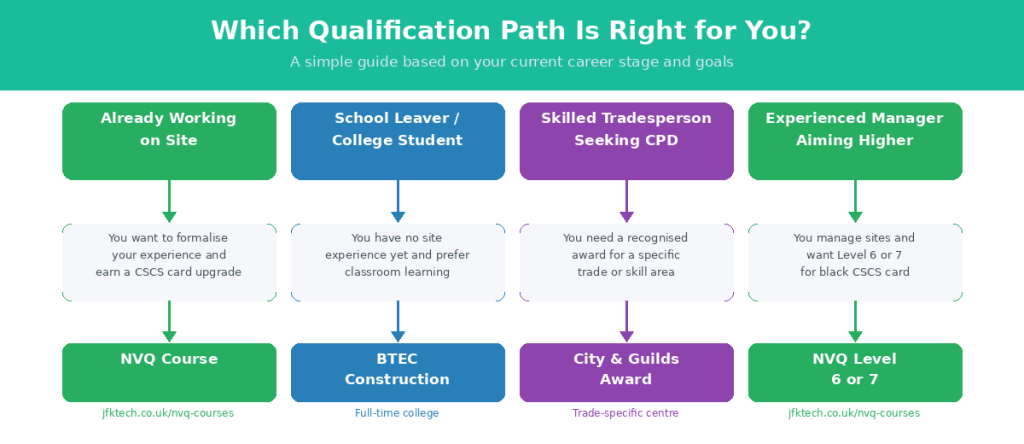
The honest answer is that the right qualification depends on where you are right now and where you want to move to. Here’s how to think about it.
Choose an NVQ if you’re already working on-site
If you have site experience and you want to formalize your competence, earn a higher CSCS card grade, and increase your earning potential, an NVQ construction course is the most direct route available to you. You don’t need to leave work to study; the assessment is built around what you already do every day. JFK Tech Training offers NVQ courses in construction that cover levels 2 through 7, so there is a program suited to wherever you are in your career right now.
Choose a BTEC if you’re entering the industry from school or college
If you have no construction experience and are entering the industry for the first time through a college pathway, a BTEC provides a solid theoretical grounding before you step onto a live site. It won’t give you a CSCS card directly, but it creates a foundation for your NVQ or apprenticeship that follows.
Use City & Guilds awards for continuing professional development
If you’re already qualified and want to add a specific accredited skill to your portfolio, like first aid, working at height, or a specialist trade certification, a City & Guilds short award is a cost-effective and respected way to do it. It complements your NVQ rather than replacing it.
Experienced supervisors and managers: go straight to NVQ Level 6 or 7
If you’ve been managing teams or sites for years and you want the Black CSCS card and the career recognition that goes with it, don’t waste time on lower-level qualifications. NVQ Level 6 in construction site management and NVQ Level 7 for senior construction professionals are the direct route. Our assessors work with you flexibly around your existing commitments.
How NVQ Construction Courses Work at JFK Tech Training
Many people assume NVQ assessment is complicated and time-consuming to manage. In practice, the process is straightforward when you have the right assessor and support team behind you.
Once you enroll in one of our nvq construction courses, you’re assigned a dedicated assessor who understands your specific trade and level. They’ll visit you on site, observe your work, and guide you through the evidence-collection process. You’re never working alone.
- Step 1: Initial assessment: We establish which NVQ level is right for your current role and experience.
- Step 2: Evidence planning: Your assessor maps out the units you need to complete and the types of evidence that will satisfy each one.
- Step 3: On-site observations: Your assessor visits your workplace to watch you working. These sessions are planned around your schedule.
- Step 4: Portfolio building: You submit witness statements, photographs, work records, and professional discussions as ongoing evidence.
- Step 5: Verification and certification: Once your portfolio is complete, it’s verified by an internal quality assurer, and your certificate is issued.
Final Verdict: Which Qualification Wins?
For most people reading this—those construction workers who are already on site and want to earn more, progress faster, and hold a CSCS card that reflects their real ability—the NVQ course is the clear winner. It’s work-based, nationally recognized, directly linked to your CSCS card grade, and assessable around your existing schedule.
BTEC qualifications are excellent for school leavers and people entering construction through a formal college route. City & Guilds awards are valuable for CPD and trade-specific certification. But neither replaces the career impact of a completed NVQ for anyone who is already working and wants to move up.
At JFK Tech Training, our NVQ construction courses range from level 2 to 7. Whether you are an operative seeking a Blue CSCS card or a senior manager aiming for a Black card, we have a program for you. Browse our full range of NVQ courses or contact us today to find your starting point.
Frequently Asked Questions
Yes—this is actually the biggest advantage of NVQs over BTEC and many City & Guilds programs. Because assessment is work-based, there are no mandatory college days or fixed lecture timetables. Your assessor schedules site visits around your working hours, and you build your evidence portfolio progressively over the course duration. It’s designed for people who can’t afford to stop working.
NVQ Level 2 typically takes between three and six months, depending on how quickly you can gather and submit evidence. NVQ Level 3 and Level 4 usually take six to twelve months. Level 6 and Level 7 can take up to eighteen months for candidates who are managing large, complex projects. The pace is partly in your hands—active candidates who submit evidence regularly tend to complete faster.
For a candidate who is already working in construction, yes, an nvq course is generally more valuable when applying for site-based roles in the UK. Employers can see immediately that you’ve been assessed against national occupational standards in a real work environment. A BTEC demonstrates academic learning, which is more relevant in early-career or management-training contexts.
Yes. NVQs are nationally recognized qualifications on the Regulated Qualifications Framework (RQF). Your nvq construction course certificate is valid and recognized by employers, principal contractors, and CSCS across England, Scotland, Wales, and Northern Ireland. Your qualification moves with you throughout your career.
NVQs are specific to your work sector. If you work in construction, our nvq construction courses are the right route. JFK Tech Training also delivers railway courses and security training courses — so if your work spans multiple sectors, our team can advise on the best qualification strategy across all of them.