If you work in the UK construction industry or you’re thinking about a career as a plant operator, the question of licensing comes up pretty fast. You’ve probably heard about the CPCS card—the Construction Plant Competence Scheme—and wondered exactly when you need one and when you don’t.
The honest answer is it depends. While CPCS certification is the gold standard for plant operators on UK commercial construction sites, not every machine and not every location falls under its requirements. This guide breaks it all down in plain language so you know exactly where you stand, whether you’re a beginner exploring your options, an experienced operator checking your compliance, or a site manager making sure your crew is legally covered.
We’ll cover what the CPCS card actually is, which machinery you can legally operate without one, which always requires it, and crucially, what to do if your card has lapsed and you need a CPCS renewal test to get back on track.
What Is the CPCS Card and Why Does It Exist?
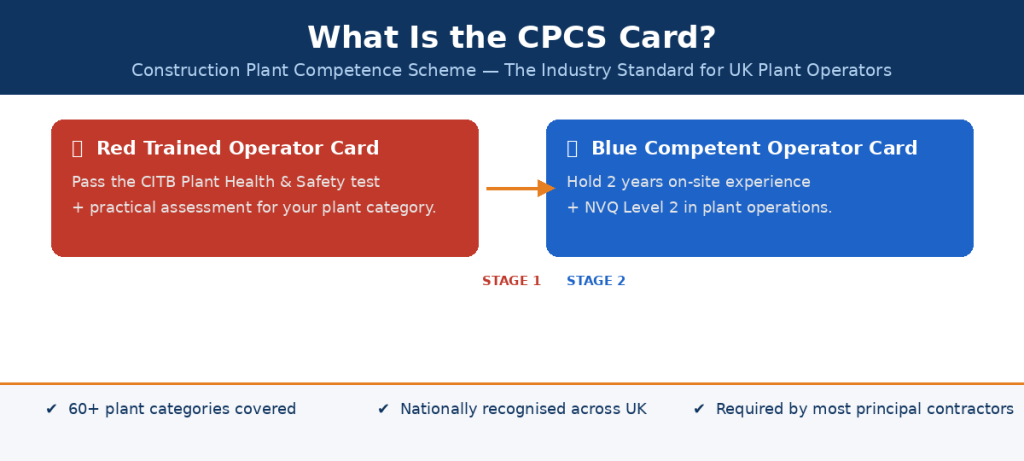
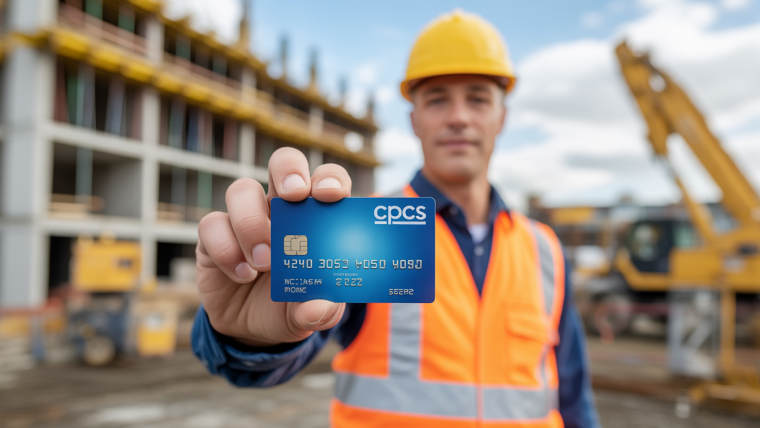
The CPCS card is the UK construction industry’s primary proof that a plant operator has been trained, assessed, and found competent to operate a specific category of machinery. It was introduced to reduce accidents on site, and it’s administered by NOCN (formerly CITB). There are two cards in the scheme.
The red-trained operator card is your entry point. You earn it by passing the CITB Plant Operator Health, Safety, and Environment test and a practical technical assessment for your chosen plant category. Think of it as a provisional license; it proves you’ve been trained, but you’re still developing your on-site experience.
The blue competent operator card is the full qualification. To upgrade from red to blue, you need at least two years of documented on-site experience and an NVQ level 2 in your plant discipline. The blue card is what most principal contractors and employers actually look for when hiring.
Both cards are tied to specific plant categories; there are over 60 in total. So if you hold a CPCS card for a dumper, you cannot legally use that card to justify operating a telehandler. If you want to operate multiple machine types, you need a separate CPCS course for each category.
Plant Machinery You Can Operate Without a CPCS License
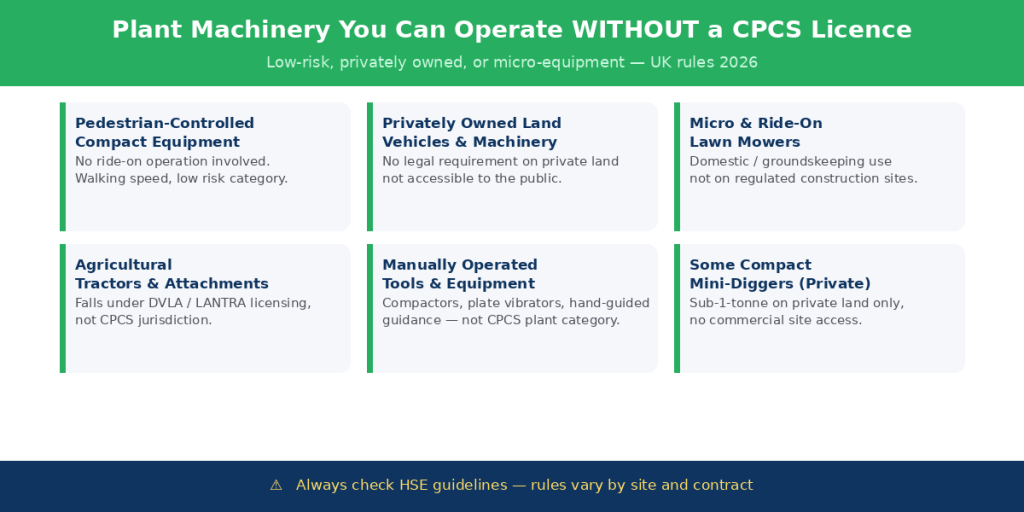
This is where a lot of people get confused — and understandably so. The law around plant machinery licensing in the UK is not always black and white. The CPCS is an industry scheme, not a piece of national legislation like the Highway Code. That means CPCS certification is sometimes a contractual requirement rather than a strict legal one. Here’s where it genuinely may not apply.
1. Pedestrian-Controlled Compact Equipment
If you’re walking behind a machine rather than riding on it, you’re often in a grey area for CPCS requirements. Pedestrian-controlled rollers, compactors, and mini-dumpers used on low-risk tasks and privately managed sites may not require a CPCS card, although many contractors choose to ask for one anyway. Always check the site rules and your contract before assuming you’re exempt.
2. Privately Owned Land Vehicles and Machinery
The CPCS scheme applies to commercial construction sites, and many workers obtain certification through CPCS training courses. If you’re operating machinery on private land that is inaccessible to the general public—a farm, a private estate, or a landowner’s own plot—there is no legal requirement to hold a CPCS card. However, your insurance policy and any contractors you hire may impose their own requirements, so always check before you start.
3. Micro and Domestic Equipment
Ride-on lawn mowers, small garden tractors, and compact groundskeeping equipment used outside commercial site environments are not covered by the CPCS scheme. If you’re maintaining a private garden or grounds, you’re not in CPCS territory.
4. Agricultural Tractors and Machinery
Agricultural machinery, including tractors used on farmland, falls under a separate licensing framework governed by DVLA and LANTRA (the sector skills council for land-based occupations). CPCS does not apply here. That said, if an agricultural tractor is brought onto a commercial construction site for civil engineering or groundwork, the rules can change, and the principal contractor may require CPCS or NPORS certification.
5. Manually Guided Tools and Hand-Guided Equipment
Plate vibrators, hand-guided compactors, and manually operated earth-moving tools are not classified as plant machinery under CPCS definitions. You don’t need a card to use these, though proper health and safety training is still strongly recommended, and in many cases it is required under CDM regulations.
6. Sub-1-Tonne Mini-Diggers on Private Land
Minimal micro-excavators used on private land for garden landscaping or small-scale private projects technically fall outside mandatory CPCS requirements. However, and this is important, the moment you take that machine onto a commercial site, a CPCS card becomes expected by virtually every contractor in the UK.
Machinery That Always Requires a Valid CPCS Card
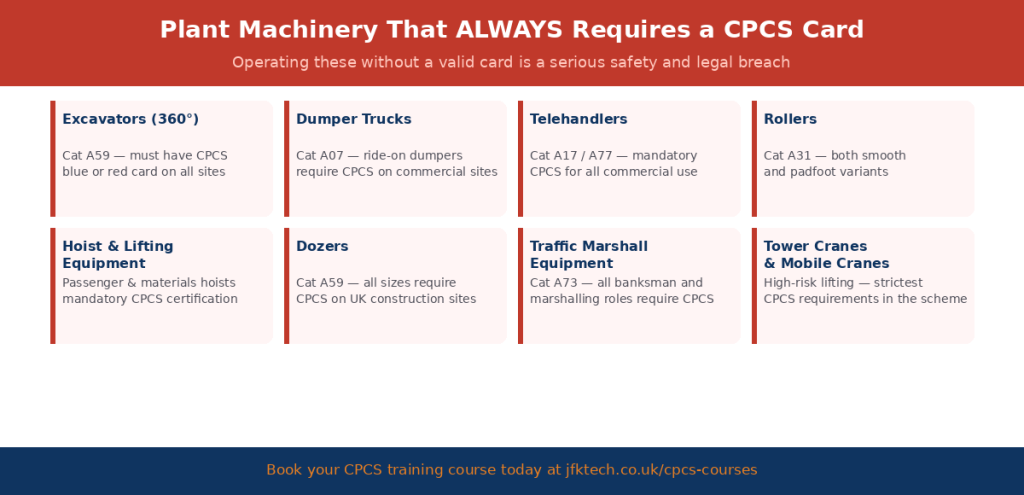
On any commercial construction site in the UK—whether it’s a housing development in London, an infrastructure project in Manchester, or a commercial build in Birmingham—the following categories of plant machinery require a valid CPCS card, without exception. Attempting to operate these without certification puts you, your employer, and everyone on that site at risk.
- 360° Excavators (CPCS Cat A59) — the most common plant type on UK sites and one of the most strictly regulated
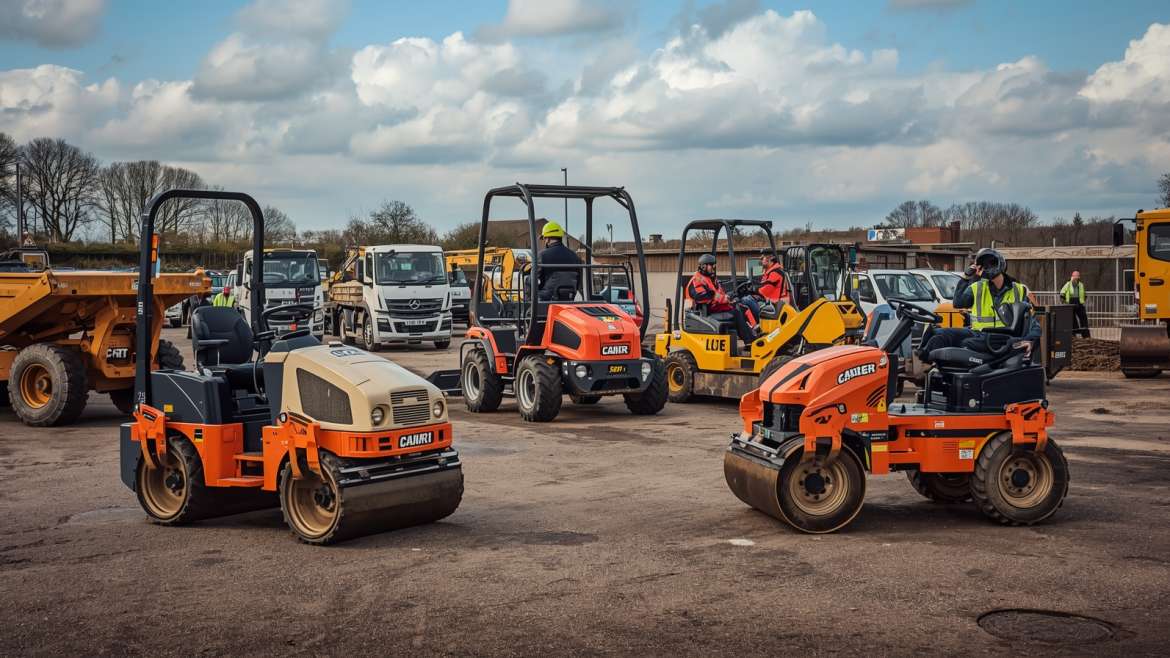
- Ride-On Dumper Trucks (CPCS Cat A07)—both forward-tip and swivel-skip variants require CPCS on commercial sites
- Telehandlers (CPCS Cat A17 and A77)—rotating and non-rotating variants both need separate category cards
- Rollers (CPCS Cat A31) — smooth drum and padfoot rollers for compaction work
- Passenger and Materials Hoists (CPCS Cat D)—high-risk lifting equipment requires full certification
- Dozers (CPCS Cat A59) — all sizes, used in earthmoving and site preparation
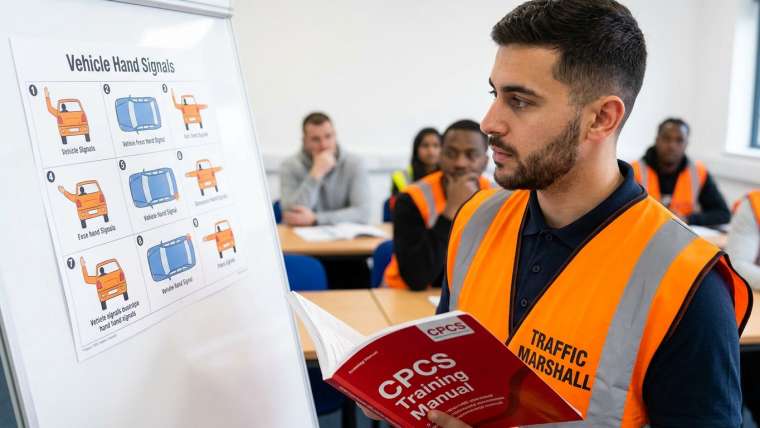
- Traffic Marshall Equipment (CPCS Cat A73) — banksmen and marshalling roles now widely require CPCS on larger sites
- Tower Cranes, Mobile Cranes, and lifting equipment are subject to the strictest CPCS requirements in the entire scheme
All of these machine types are available as dedicated CPC training courses at JFK Tech Training. Our center delivers everything from the CPCS Roller A31 and Dumper A07 right through to the Telehandler A17 and beyond.
What Happens If Your CPCS Card Has Expired?
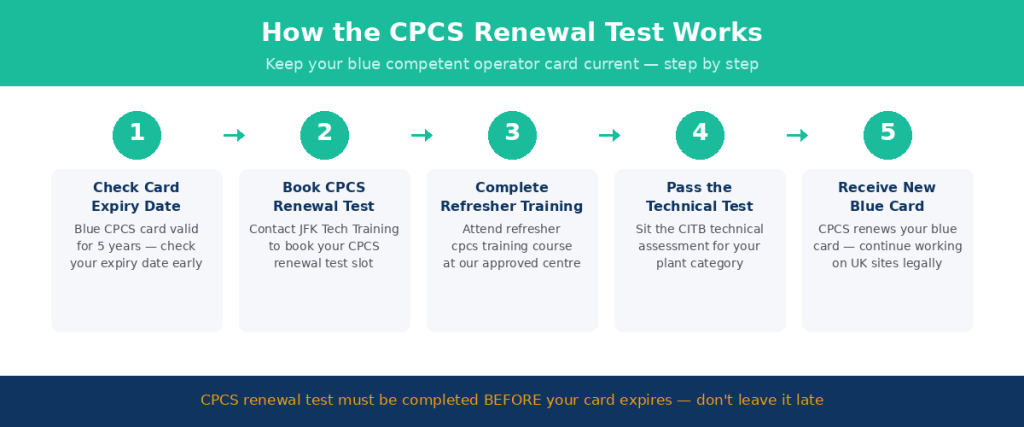
This is one of the most common situations we encounter at JFK Tech Training. Operators who qualified years ago worked consistently and then let their cards lapse, sometimes without even realizing they had expired. It happens more often than you’d think.
If your CPCS blue card has expired, you cannot legally operate plant machinery on a commercial UK site. Site managers are required to verify cards, and an expired card is treated the same as no card. You will be asked to stand down until the situation is resolved.
The positive news is that renewing is straightforward. You complete a CPCS renewal test—typically a refresher training session followed by a CITB technical assessment for your plant category. At JFK Tech Training, we handle the full process. We schedule your test slot, equip you for the technical questions, and ensure the swift renewal of your card.
Here’s a key thing many people don’t realize: if your blue CPCS card has been expired for a significant period, you may need to demonstrate that you have maintained recent on-site experience. This is why we always recommend checking your expiry date well in advance, ideally six months before it lapses, so you have time to book your renewal without any gaps in your ability to work.
CPCS vs NPORS—Which Should You Choose?
Both CPCS and NPORS (National Plant Operators Registration Scheme) are accepted on UK construction sites, but they are not always interchangeable. If you’re working on large commercial projects, infrastructure schemes, or for principal contractors, CPCS is almost universally expected. Smaller projects and certain specialist sectors more commonly see NPORS cards.
For anyone planning a long-term career as a plant operator—particularly in London and across major UK cities—a CPCS card gives you the strongest possible position. It’s recognized by virtually every principal contractor, it’s directly linked to your NVQ pathway, and it’s the card that most employers name first in job ads.
If you’re not sure which route is right for your circumstances, our team at JFK Tech Training is happy to advise. You can also read our full breakdown of available construction courses to understand how CPCS fits into the wider picture of UK construction qualifications.
How to Get Started With Your CPCS Course
- Getting your CPCS card is a straightforward process when you have the right training provider behind you. Here is how a typical CPCS course works at JFK Tech Training.
- Choose your plant category. We currently offer training in CPCS Roller A31, Dozer A59, Dumper A07, Hoist, Telehandler A17, Telehandler A77, 360 Lifting A59, and Traffic Marshall A73.
- Book your course. All our CPCs’ training courses are all-inclusive at £500 per category, covering theoretical knowledge, practical sessions, and test preparation
- Pass the CITB Plant Operator Health, Safety, and Environment test. We help you prepare for this exam—most candidates find it the most challenging part.
- Complete the practical technical test at our approved assessment center.
- Receive your red CPCS card and begin building your two years of on-site experience toward your blue competent operator card.
For a full list of available categories and to book your place, visit our website. If you have questions about which category suits your current role, etc.
Final Thoughts
Knowing where CPCS is required and where it isn’t helps you understand your duties as a plant operator and make better training choices. While there are legitimate situations where you can operate certain machinery without a CPCS card, on any UK commercial construction site in 2026, a valid CPCS card is practically non-negotiable. Whether you need your first CPCS course, a CPCS renewal test to get your expired blue card reinstated, or you want to expand into new plant categories with accredited CPCS training courses—JFK Tech Training has you covered.
Frequently Asked Questions
Yes—on genuinely private land that is inaccessible to the public, CPCS is not a legal requirement for sub-ton equipment. However, your insurance provider may have different views, and any contractor or landowner who engages you may still ask for evidence of competence. Training is always advisable.
It depends on the plant category. Our Roller A31 and Dumper A07 courses run for two days. The Dozer A59 is a five-day program. Most categories sit somewhere between two and five days. The CPCS renewal test refresher is typically shorter—usually one to two days—because you’re already experienced and just need to demonstrate current competence.
You will be asked to leave the site immediately. Beyond that, your employer may face enforcement action from the HSE, and any accidents that occur could result in serious personal and corporate liability. It is simply not worth the risk.
To upgrade from the red trained operator card to the blue competent operator card, you need an NVQ Level 2 in plant operations alongside your two years of on-site experience. JFK Tech Training offers both CPCS training courses and NVQ plant operation courses, so you can complete the full pathway with one provider.